
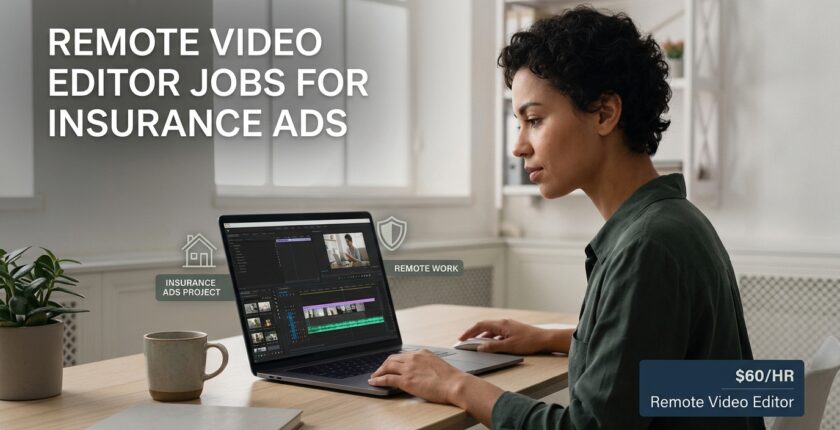
Remote Video Editor Jobs for Insurance Ads – $60/hr: Your 2026 Guide to Premium Pay
Most remote video editors hear “insurance ad” and immediately picture grey stock footage, stiff handshakes, and disclaimers eating half the frame. It doesn’t exactly scream creative freedom. But that snap judgment is exactly why the niche is so profitable. While everyone else fights over flashy tech promos and $20-per-edit social clips, insurance carriers and agencies are quietly paying $60 an hour for editors who can handle the one thing most creatives ignore: legal precision.
Insurance video editing isn’t boring corporate drivel. It’s high-stakes storytelling with legal teeth. One misplaced disclaimer, one truncated “limitations and exclusions” audio line, and an entire campaign can get pulled — or a carrier can face serious regulatory heat. That risk doesn’t make the work dull. It makes skilled editors rare. And rare skills command premium pay. That’s the whole game in a sentence.
Let’s talk about why “boring” insurance ads have become a goldmine for remote editors — and how you can position yourself to get paid at the top of the market.
Why “Boring” Insurance Ads Are a Goldmine for Remote Video Editors Right Now
Look, I get it. When you hear “insurance video,” your brain probably conjures up cheesy stock footage of a smiling family and a voice‑over droning about deductibles. But here’s what most freelancers miss — that perceived dullness is your competitive moat. Generalist editors run from these projects. They think they’re beneath them. And that leaves a massive, cash‑rich vacuum.
Right now, independent insurance video production agencies and in‑house marketing teams at carriers are scrambling for editors who actually get it. They’re tired of explaining the difference between a binder and a policy to some video guy on Upwork who just wants to export and move on. So, if you’re willing to embrace the slightly unsexy side of post‑production, you can name your price. I’m not joking. The $60/hr figure isn’t a carrot I’m dangling. It’s the going rate for a competent remote video editor for insurance companies who can navigate this niche without hand‑holding. And there’s a reason for that — let’s break it down.
What Exactly Are Remote Video Editor Jobs for Insurance Ads? (And What Makes Them Pay $60/hr?)
This isn’t just slapping clips on a timeline. A Remote Video Editor Jobs for Insurance Ads gig is a weird, wonderful hybrid of creative editor, legal proofreader, and brand protector. You’re crafting an insurance marketing video that must simultaneously persuade a consumer, satisfy a state insurance commissioner, and make the agent who paid for the spot look like a hero.
Beyond the B‑Roll: The High‑Stakes World of Insurance Video Production
Here’s the thing most outsiders don’t see. A standard 30‑second insurance commercial might need to feature seven seconds of mandatory on‑screen legal text, an audio disclaimer that can’t be buried in the mix, and — depending on the state — a specific font size that a regulator can actually measure. You can’t just cover it up with a fancy LUT and call it a day.
I once worked on a Medicare Advantage spot that had different compliance requirements for Florida, Texas, and New York in the same campaign. My job? Cut it cleanly so the client could swap out the end cards without re‑editing the whole emotional arc. That’s the kind of problem that makes agencies happily pay a premium. They’re buying peace of mind. They’re buying an editor who won’t land them a cease‑and‑desist letter. Solve that pain, and you’re instantly in the $60/hr club.
Decoding the $60/hr Rate: Specialization vs. Generalisation
You know what a generic social‑media reels editor earns? Maybe $25‑$35/hr on a good day, and that’s if they’re not stuck in a race‑to‑the‑bottom bidding war. And hey, there’s nothing wrong with that work. But the moment you can put “insurance video editing compliance” on your website, you’ve left the commodity market. You’re now a specialist.
The economics are simple: a generalist editor is a cost; a specialist is an investment. I’ve had agency owners tell me they budget up to $75/hr for **remote video editing services for insurance** because a mistake in the edit could cost them the client’s entire contract. So that $60/hr? It’s not a generous gift. It’s the market correctly pricing the risk you’re absorbing. When you present yourself as the editor who speaks “insurance,” you’re not just offering a service. You’re offering a very specific, highly valuable form of risk mitigation. And that, my friend, changes the pay scale entirely.
The 7 Non‑Negotiable Skills to Command High‑Paying Insurance Video Editing Jobs
Ready to actually earn that rate? You need a blend of left‑brain precision and right‑brain empathy. I’ve boiled it down to three critical skills that will make you irreplaceable. (Because honestly, if I listed all seven, we’d be here all day — and you’d just skim them.)
1. Mastering the “Compliance Cut”: Keeping It Legal Without Losing the Viewer
I coined this term after my disaster with the small font. The “compliance cut” is the art of integrating legally mandated language so seamlessly that it feels like a creative choice. It’s about timing. If you need a 15‑second disclaimer on a 30‑second ad, you don’t just slap it at the end over a blank screen. You weave it in.
I use subtle kinetic typography timed to a heartbeat‑like sound design bed, so the disclaimer actually builds the emotional urgency. You learn to love the challenge of making a bulleted list of exclusions feel like a reassuring promise. It’s weirdly satisfying. And when you nail it, the client doesn’t just approve the edit; they exhale with relief. That’s what they’re paying for.
2. Storyboarding for “Trust”: How to Cut Agency‑Footage into an Empathetic Narrative
Insurance, at its core, isn’t about policies. It’s about the dread of what happens if something goes wrong. Most raw agency footage is terrible: stiff handshakes, awkward agent talking‑heads, generic B‑roll of keys being handed over. Your job is to find the emotional thread.
I always ask myself: “Where is the fear in this footage, and where is the relief?” I might open a spot on a close‑up of a woman looking worried at her water‑damaged basement, hold on her face for a beat too long — make it uncomfortable — and then cut hard to the agent’s calm voice promising restoration. It’s a simple narrative arc, but it works. You’re editing for trust, not awards. That empathetic touch is what makes an agency want to lock you in for every project.
3. Technical Chops: Remote Collaboration in Adobe Premiere Pro, After Effects & Frame.io
Now, the tools. I’ve built entire high paying remote video editor jobs around a solid Adobe workflow. While Premiere Pro handles the cutting, After Effects is your best friend for creating compliant motion graphics templates for insurance ads that can be updated per state without breaking a sweat. And for remote review? Forget endless email chains. Frame.io is non‑negotiable.
I train my clients to leave time‑stamped notes directly on the timeline. “The disclaimer at 0:12 needs a 0.5‑second longer hold for legal.” Done. No confusion. Also, a less‑obvious tool? Audition’s noise‑reduction for cleaning up those awful Zoom‑recorded agent testimonials where the audio sounds like they’re in a tin can. That audio cleanup alone can make a spot feel premium. I’ve found that many editors ignore audio, but in insurance, the spoken disclaimer is often legally binding. If it’s muffled, the ad is non‑compliant. So, your technical chops directly tie back to that $60/hr value.
Where the Jobs Are Hidden: How to Find Legitimate Remote Video Editor Jobs for Insurance Ads
So, you have the skills. Where’s the money? It’s not sitting on a job board titled “cool creative gigs.” You have to dig, and you have to get a little uncomfortable.
Skip the Crowded Platforms: Niche Insurance Marketing Agencies Are Desperate for You
Log off of Fiverr and the general Upwork feed for a second. I’m serious. The real gems are the agencies that only serve insurance companies. Go to Google, type “insurance marketing agency [state],” and build a list of 50 firms. These agencies churn out localized TV spots, YouTube pre‑rolls, and social ads for dozens of regional carriers. They are perpetually behind on editing and terrified of hiring someone who doesn’t understand compliance. They’re not even posting jobs. They’re just overloaded. This is where you pitch.
LinkedIn X‑Ray Searches for the $60/hr Remote Video Editor for Insurance
Here’s a little trick I’ve used for years. Take this Boolean string and paste it into LinkedIn’s search bar: (“insurance” OR “agency”) AND (“video editor” OR “post production”) AND “remote”. Then filter by “Posts” from the last month. You’ll find creative directors and agency owners moaning about deadlines. Reach out. Another string: “compliance” AND “video” AND “editor”. It’s surgical. You’ll bypass all the noise and find companies actively discussing their pain points. It’s like finding a secret door in a wall everyone else is just staring at.
The “Problem‑First” Cold Pitch That Landed Me a $6,000 Retainer
Forget “Hello, I’m a video editor with 10 years of experience.” Yawn. I won a client by recording a 90‑second Loom video analysing their latest Facebook ad. I pointed out that their required fine print on the screen was illegible on mobile, and that their audio disclaimer was technically too fast per some state guidelines I’d researched. I wasn’t criticising to be a jerk. I showed them I was the only person paying attention.
My message was: “Saw your ad, love the message, caught a potential compliance hiccup that might get you flagged — want me to show you a quick fix?” They replied in 45 minutes. That led to a $6,000 retainer to clean up their entire ad library. I wasn’t selling editing. I was selling safety and authority. That’s the difference.
Cracking the Code: How to Interview for an Insurance Video Editor Remote Position
You’ve got the call. Now you need to prove you’re not a faker. The interview for these niche gigs is less about your creative vision and more about your process.
Building a Portfolio That Screams “I Understand Regulated Industries”
What if you’ve never cut an insurance ad? No worries. Take a public‑domain insurance commercial from the 90s on Archive.org and recut it. But don’t just make it look modern. Add a new legal end card that complies with current NAIC model guidelines. Create a side‑by‑side split screen: before and after, showing your compliance fix. I call it a “spec makeover.” It’s the fastest way to demonstrate you know the rules without having the client list yet. Include this in your insurance video editing jobs remote portfolio alongside a note about why you made each change. It’s a conversation starter that sets you miles apart.
The “Dreaded” Question: “How Do You Handle Compliance Revisions?”
Ah, the big one. Here’s what you say: “I treat them as the foundational brief, not an afterthought. I’ll build the timeline around the required legal language first — so the creative frames the compliance, not the other way around. And I always leave a two‑second pad at the end of each compliant segment because regulations can shift mid‑project.”
When you say that, you’ve just told the hiring manager that revisions won’t be a panicked, costly mess. You’ve made their life easier. And that’s the whole game, isn’t it? Frame revisions not as annoying client notes, but as the very reason they need a specialist like you. Your job security isn’t the flashy cut; it’s the fact that you can read an insurance bulletin and translate it into a keyframe.
Beyond the Hourly Rate: Building a Lucrative Remote Career in Insurance Video Production
Once you’ve got a couple of $60/hr projects rolling, don’t just sit there. Pivot into the real goldmine.
From One‑Off Ads to Annual Retainers: The Agent Training Video Goldmine
Here’s the insider secret: the ad budget is tiny compared to the training budget. Insurance carriers and large agencies are legally required to do hours and hours of continuing education and internal product training. They need videos. Boring, lengthy, repetitive videos that need clean audio, clear lower‑thirds, and organised chapter markers. It’s not glamorous, but it’s the steadiest income I’ve ever had.
I charge a flat monthly retainer to be the “on‑call” editor for a firm’s training content. It’s less creative, sure, but it’s predictable, and my hourly effective rate often goes up because I can batch the work. Many insurance commercial editor roles I’ve landed started as a one‑off ad and evolved into this steady stream of insurance explainer video editor assignments. It’s the ultimate evolution of that niche.
Ready to Quit the Race to the Bottom? Let’s Match You With a Client Who Values Your Expertise
You know what? There’s a whole class of editors out there trying to convince a dropshipper to pay them $15 to edit a TikTok. And then there’s you, armed with the knowledge that a compliance‑ready, empathetic insurance edit is worth a whole lot more. I’ve seen too many good editors burn out on garbage gigs when this industry is sitting right here, starved for talent.
Browse the Hand‑Vetted Remote Video Editor Jobs for Insurance Ads on Our Platform
If your fingers are itching to try that “compliance cut” or send a cold pitch to an agency you just found, then the next logical step is finding a client who’s already looking for you. We’ve done the heavy lifting — filtering out the low‑ballers and the scammers. Take a look at our latest Remote Video Editor Jobs for Insurance Ads, vetted specifically to match the $60/hr quality tier. No race to the bottom. Just a straight line to clients who get it. Go get ‘em.

Arsalan is an independent AI tools researcher and
digital publisher. He tests free and paid AI tools,
tracks the remote AI job market, and writes practical
guides for professionals who want to work smarter
with AI.
Now focused on
AiGetPro — a resource for honest AI tool comparisons,
remote AI job guides, and free GitHub tool discoveries.
