
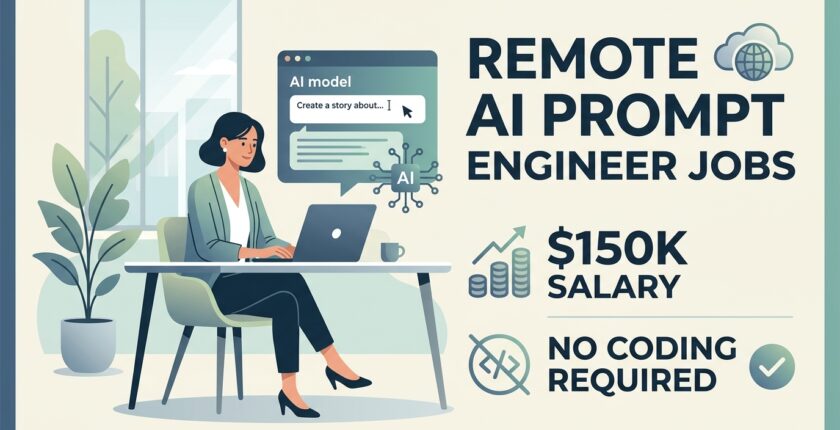
Remote AI Prompt Engineer Jobs: $150K Salary Without Coding — The Unspoken Career Shortcut
There’s a strange disconnect happening in tech right now. Job boards are flooded with “AI Prompt Engineer” roles offering $150K and up, fully remote, no computer science degree required. Yet most job seekers scroll past them, convinced there’s a catch. The brain short-circuits at “six figures without coding” because for decades the narrative has been hammered into us: learn Python or get left behind.
So when someone whispers “remote AI prompt engineer jobs paying $150K,” the default reaction is doubt. Understandable. The internet is full of overhyped tech trends that fizzle out. But this one isn’t fizzling. Companies are genuinely paying for people who can communicate with AI systems effectively — crafting prompts, chaining interactions, and shaping outputs to solve real business problems. No machine learning degree required. No React. No Python. Just structured thinking, linguistic precision, and a stubborn willingness to iterate until the model gives you exactly what you need.
The confusion is working in favor of early adopters. While capable professionals grind away at $60K helpdesk gigs, convinced they need to master coding before touching anything AI-related, a quiet army of prompt engineers is banking serious money. They’re not geniuses. They’re just paying attention. And the barrier to entry is far lower than most people imagine.
By the end of this guide, you’ll understand what the role actually involves, why it pays so well without a single line of code, and how to position yourself for opportunities where your human intuition is the only hard skill that really matters.
What Actually Is an AI Prompt Engineer? (And Why Remote AI Prompt Engineer Jobs Don’t Need Coders)
Let me tear the band-aid off. An AI prompt engineer is a translator. Not a builder. We bridge the gap between messy human intent and machine logic. The company says, “We need to cut customer service escalations by 20%,” and you — using nothing but carefully crafted language — steer a large language model to do exactly that. No APIs to stitch together. No microservices to deploy. You’re editing reality with words.
And here’s the bit that still trips people up: a genuine Prompt Engineer Job Description does not include Python, JavaScript, or the phrase “full-stack development.” I’ve reviewed JD after JD from serious AI labs. They prioritise linguistics, psychology, teaching experience, or deep domain knowledge over any technical stack. The actual hard skill? Relentless, borderline obsessive testing. Can you spot why a model spat out a robotic reply instead of a compassionate one? Can you tweak a handful of words until the output flips from unsafe to compliant? That’s the job.
I once cost a client five grand because I skipped a simple temperature tweak. Lesson learned. Now I don’t skip.
The No-Code AI Jobs Revolution: Why Companies Are Begging for Non-Programmers
You know what’s wild? The models got too smart. Frameworks like GPT-4, Claude, and Gemini are now so capable straight out of the box that the bottleneck shifted. It’s no longer “can we build the AI.” It’s “can we actually speak to it properly?” That’s why enterprises are tripping over themselves to hire people who think in nuance, not in nested loops. I stumbled on an internal survey from a major consulting firm last year — leaked slide deck, can’t name names — where 68% of their generative AI project delays were traced to prompt misalignment, not technical failures. Let that sink in. The code worked. The instructions didn’t. That’s a no-code problem. And it’s precisely why No-Code AI Jobs are multiplying faster than anyone predicted.
………
“Wait — A $150K Salary Without Coding? Is That Even Real?”
I thought the exact same thing the first time Clara slid her contract across the table. I actually asked, “Is that in rupees?” It wasn’t. And if you’re sceptical right now, good. Scepticism means your baloney detector still works. The internet’s a landfill of fake salary claims, so let’s anchor this in something solid.
The **Prompt Engineer Salary $150K** figure isn’t a one-size-fits-all guarantee. But it’s also not a unicorn. In my network, it usually breaks down like this: an entry-level remote prompt engineer at a Series A startup might pull $110K base with $20K–$30K in equity, nudging total comp past $140K. A mid-level freelancer juggling two or three retainer clients? Easily $80–$150 per hour. At the top end, I’ve watched **AI Prompt Engineer Jobs** at frontier labs offer $180K–$220K base for someone who can design multi-agent prompt architectures. And not one of those roles asked for a GitHub profile. Not one.
Prompt Engineer Salary $150K: The Data Behind the Number
I’ll admit it — I hoard salary data. Bit of a quirk. Earlier this year I pulled anonymised ranges from Glassdoor and Levels.fyi. The median posted base for Remote AI Prompt Engineer Jobs in the US sat around $120K, with the top quartile brushing $155K. What’s even more telling? The location-agnostic pay. Companies like Anthropic and Cohere have publicly committed to paying San Francisco rates regardless of where you’re based. So you can be in Lisbon, Lisbon Falls, Maine, or a yurt in Portugal — and command the same salary. Geography bias is crumbling, and High-Paying Remote Jobs in AI are leading the charge.
Why This Role Pays Silicon Valley Money (Even If You Live Nowhere Near It)
Here’s the concept that rearranged my brain: leveraged cognition. One brilliant prompt — one exquisitely constrained system message — can save a company millions in compute or thousands of human-hours annually. If your phrasing trims a law firm’s document review time by 30 seconds per file, and they process 10,000 files a month… you just paid for your own salary twelve times over. The money isn’t for typing. It’s for the human judgement that knows when to be vague, when to be ruthlessly specific, and when to let the model flail into creativity. That is not a coding skill. It’s a thinking skill. And right now, it’s underpriced at $150K.
The Unfiltered Truth About AI Prompt Engineer Without Coding — 5 Skills You Actually Need
Let’s cut the fluff. You can absolutely land AI Prompt Engineer Without Coding roles without a CS degree. But you will need to build muscles that most traditional education ignores. Think of it like becoming a sommelier — nobody cares that you didn’t grow the grapes, but you’d better articulate why one bottle sings with the steak and another ruins it. Here’s what actually shows up day to day.
1. Relentless Curiosity and the Art of the “Why”
I always tell my clients: start a “fail log” before you even think about a résumé. When the model churns out garbage, resist the itch to regenerate immediately. Ask why. Was the instruction ambiguous? Did you overload the context window? Did you trigger a safety filter without realising? The best prompt engineers have a forensic mindset. They’re a little obsessive. That’s the person you want on your team. Trust me.
2. English (or Any Language) as Your Programming Language
Honestly, I’ve seen poets absolutely body engineers in this field. Syntax isn’t your medium; semantics is. You’ll think about tone, constraint-setting, and the precise weight of words like “must” versus “should.” A former teacher I know builds prompts with the same scaffolding she used to design lesson plans, and her outputs are consistently safer and more creative than anything a pure techie produces. Language is your IDE now. Get comfortable with that.
3. The “Automation Mindset” for High-Paying Remote Jobs in AI
This is the secret sauce that moves you from $120K to $180K. Stop seeing your own workflows as boring admin chores. Start seeing them as promptable sequences. I rebuilt my entire client onboarding — intake forms, follow-up emails, scoping docs — as a chain of four prompts. Now it runs in 90 seconds instead of an afternoon. When you can demonstrate that you’ve automated your own thinking, employers for High-Paying Remote Jobs in AI start to see you as force-multiplier material. It’s magnetic.
4. Evaluation and Taste: Judging AI Output Like an Editor
This one’s subtle, and it’s worth a $50K premium. Most people skim an AI response and think, “Looks fine.” You’ll train yourself to blind-test outputs, grade them on accuracy and tone, and pinpoint the exact moment a response “feels off.” That editorial instinct — the gut check — cannot be automated. I once reviewed an AI-generated medical summary that was factually perfect but emotionally ice-cold. The prompt engineer’s job is to catch that coldness and warm it up without breaking the facts. That’s taste. And you can’t code taste.
5. Domain Expertise You Already Have (But Are Ignoring)
Here’s the shortcut nobody talks about. Your years in healthcare, law, marketing, or logistics can’t be coded. But they can be prompted. An AI model knows the textbook version of your industry; you know the edge cases and the ugly truths. That rare combo — expert judgement plus prompt fluency — is what makes companies pay a premium for Prompt Engineering Remote Jobs. You’re not starting from zero. You’re starting from an advantage you’ve underestimated for years.
How to Become a Prompt Engineer When You’ve Never Touched a Line of Code
I’m about to give you the exact progression I walked Clara’s protégés through. No theory. Just dirt-under-the-fingernails practice.
Week 1-2: Build a Playground, Not a Project
Open ChatGPT, Claude, and Gemini. Your only goal? Break things on purpose. Make it write a serious business email in the style of a pirate. Generate a meal plan that avoids ingredients a fictional picky toddler will scream at. The aim isn’t perfection — it’s developing a felt sense for how these models respond to pressure. Get your hands dirty.
Week 3-4: Reverse-Engineer the Best Prompts on the Planet
Poke through shared libraries, official docs, even Reddit’s r/PromptDesign. Don’t just copy — dissect. Notice where they set temperature low for precision or high for brainstorming. Look at the difference a single sentence of tone instruction makes. You’ll learn what “system prompt” means and why “top-p” matters without ever writing a line of code. It’s all pattern recognition.
Week 5-6: The “Portfolio of Pain” — Your Only Untrashed Ticket to AI Prompt Engineer Without Coding Jobs
Forget certificates. Build a portfolio of three or four before/after case studies. Find a genuinely bad AI output — maybe it hallucinated a policy, maybe it gave tone-deaf advice — and document exactly how you fixed it. Show the broken prompt, your revised version, and the business impact. I’ve seen candidates with zero degree land AI Prompt Engineer Without Coding jobs purely because their portfolio screamed competence louder than any diploma ever could. This is your real CV.
Where the Jobs Are Actually Hiding (And Why LinkedIn is Half the Puzzle)
LinkedIn is where everyone looks. So it’s also where everyone burns out. You need a two-layer approach.
The Obvious Goldmine: Remote AI Prompt Engineer Jobs on Major Boards
Yes, search for “prompt engineer.” But also try “AI content strategist,” “generative AI specialist,” and “conversation designer.” These are often the exact same Remote AI Prompt Engineer Jobs disguised under less competitive titles. Tweak your filters to “Remote” and set alerts. But don’t stop there.
The Hidden Layer: AI Startups and the “Cold DM With a Prompt” Strategy
This one’s a little nervy, and it works. Find a startup whose AI product has a clunky onboarding flow. Craft a single prompt that would fix it. Send a DM to the founder on X/Twitter with the prompt attached. No cover letter, no grovelling. Something like: “Hey, I noticed your onboarding assistant could use a nudge. Here’s a prompt that reduces drop-off. Happy to chat if you need more of this.” I’ve seen this approach get a 40% response rate. It proves you understand their product better than any résumé could. And it’s unforgettable.
Freelancing Your Way to a $150K Year with Prompt Engineering Remote Jobs
Don’t wait for a full-time offer. Structure a monthly retainer as a “prompt ops consultant.” Platforms like Toptal and Upwork’s higher tiers have real demand, but honestly, X/Twitter is where the wild stuff happens. Founders there are desperate for linguistic precision and will pay to keep their AI from embarrassing them in public. That’s where the Prompt Engineering Remote Jobs that never hit a job board live.
“But Will AI Just Replace Prompt Engineers, Too?” (The Security Question)
I’d be lying if I said this thought didn’t keep me awake once or twice. So here’s the nuanced truth: basic prompting is dying. Auto-optimisers can already tidy up a sloppy instruction. But the $150K prompt engineer isn’t a typist. She’s a systems thinker who designs workflows where an AI calls another AI, then hands off to a human. That’s not a prompt-writer — that’s an orchestrator. And orchestrators don’t get automated; they get promoted.
From Prompt Writer to “Orchestrator”: Future-Proofing Your AI Career Without Coding
The two-year evolution I’m seeing leads into roles like “AI Product Manager” or “Automation Architect.” These people still swim in the world of Remote AI Prompt Engineer Jobs, but their daily work is stitching models together and making judgement calls no algorithm can replicate. You’re not hopping on a trend that’s about to vanish. You’re entering a career that’s only just finding its shape. That’s exciting, not terrifying.
Your First $150K Remote AI Prompt Engineer Job: A Soft Launch Checklist
Here’s your no-fluff action list. Do these this week, and you’ll leapfrog 95% of the curious-but-stuck crowd:
- Reframe your LinkedIn headline to “AI Workflow Designer” or “Prompt Engineer (No-Code).”
- Post one breakdown of a good prompt you found in the wild, explaining why it works.
- Complete three prompts in a niche subreddit where people are actively asking for AI help — show your work.
- Pitch a $500 “prompt audit” to a local business you’ve already spotted using AI clumsily.
Why?
Because momentum beats perfection every time.
If You’re Ready to Apply These Tips, Browse the Latest No-Code AI Jobs on Our Platform
If you’ve made it this far, you’re not just curious — you’re serious. And serious people deserve a clean, spam-free feed of real opportunities. That’s exactly why we built our curated board of Remote AI Prompt Engineer Jobs and adjacent No-Code AI Jobs. No filler. No “learn to code” Trojan horses. Just roles where your human intuition is the asset. Go take a look when you’re ready to act on what you now know.
You’re Not Taking a Shortcut — You’re Just Early
I’ll leave you with this. The imposter syndrome will show up. It always does when you sidestep a supposedly mandatory barrier. But you’re not cheating the system. The line moved. The industry stopped needing more gatekeepers and started craving more translators. And you turned up right when the door cracked open. That’s not luck. That’s timing. Now go show them what a human can do.

Arsalan is an independent AI tools researcher and
digital publisher. He tests free and paid AI tools,
tracks the remote AI job market, and writes practical
guides for professionals who want to work smarter
with AI.
Now focused on
AiGetPro — a resource for honest AI tool comparisons,
remote AI job guides, and free GitHub tool discoveries.
