
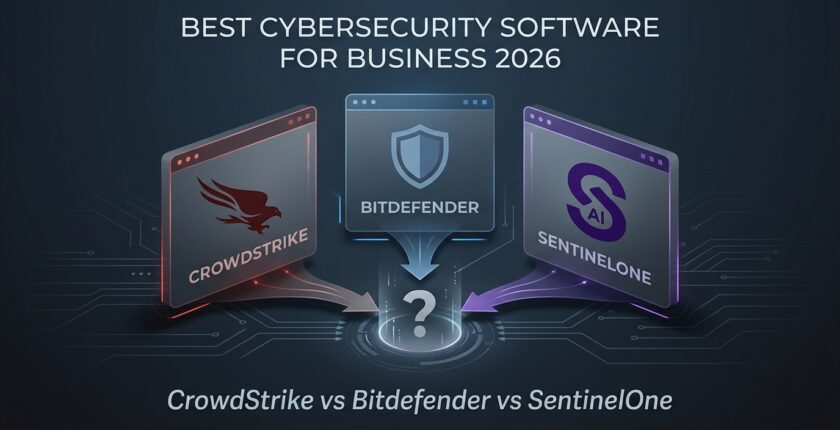
CrowdStrike vs Bitdefender vs SentinelOne: EDR pricing, ransomware rollback & Zero Trust compared. Best endpoint security for SMBs in 2026.
The phone doesn’t ring at 3:14 a.m. with good news.
You fumble for it in the dark — heart already hammering before you’re even fully awake — and the voice on the other end is your operations manager, except it doesn’t sound like him. Three words, barely above a whisper: “Everything’s locked. Encrypted.” You stagger to your laptop, hands shaking, and every file, every invoice, every customer record now ends in a string of random characters. The ransom note sits on your screen like a dare. No alarms went off. No warning. Just a business — yours — frozen solid at the worst possible hour.
That cold drop in your stomach? We’re here to make sure you never feel it.
The Uncomfortable Truth About Business Cybersecurity in 2026
Everyone’s been saying “it’s not a matter of if, but when” for so long it’s basically background noise by now. But here’s what has genuinely changed — and fast — the economic barrier to launching a ransomware attack is now effectively zero.
Ransomware-as-a-Service kits are sold on dark web forums with affiliate dashboards, commission structures, and — I wish I was joking — 24/7 customer support. The attacker who encrypted that hypothetical business above didn’t write a single line of code. They paid a subscription. The underground economy for attack tools has matured faster than most enterprise security teams have adapted to it, and small businesses are paying the price.
The Threat Landscape Has Fundamentally Shifted — Has Your Protection?
The Ransomware-as-a-Service Economy
IBM’s 2025 Cost of a Data Breach Report puts the average total impact of an SMB breach at $4.88 million. Every time I show that number to a small business owner, they assume it’s an enterprise figure. It’s not. That number accounts for downtime, regulatory fines, reputational fallout, customer churn, and recovery costs — the full economic gut punch, not just the ransom itself. And that figure doesn’t include what you’ll spend on cyber insurance premiums afterward, which climb sharply for businesses that lacked documented endpoint security controls before the incident.
The attack surface keeps expanding while the skill floor for attackers keeps dropping. Traditional antivirus? Honestly, attackers test their payloads against the top 60 endpoint security engines before launch. By design, your signature-based scanner is already blind to what’s coming.
Your Endpoints Are Ground Zero
Here’s the number that should actually keep you up: 94% of breaches originate at the endpoint — the laptop on your CFO’s kitchen table, the Windows workstation in your warehouse. And 68% of breaches involve a human element, which sounds like a training problem until you realize that clicking employee is usually the last domino in a chain of technical failures that should have been caught three steps earlier.
Modern attack chains don’t break in — they log in. Phished credentials, unpatched vulnerabilities, and legitimate system tools repurposed for lateral movement mean that signature-based antivirus is a museum piece. This is the cyber threat landscape in 2026: highly automated, credential-driven, and endpoint-focused.
Why Legacy AV Fails Against Modern Threats
Next-generation antivirus (NGAV) exists precisely because traditional antivirus relies on known file hashes — and modern attackers compile novel fileless malware that never touches the disk. Fileless attacks live entirely in memory, hijacking legitimate system processes like PowerShell or WMI to execute malicious code without leaving a file for a signature scanner to catch.
Zero-day exploits compound this further: by definition, there’s no signature to detect what nobody’s seen before. Attackers weaponize newly discovered vulnerabilities before vendors can patch them, meaning your legacy endpoint vulnerabilities remain open long after you think the risk is managed.
The only reliable answer is behavioral AI — monitoring what processes do rather than what they are. That’s the core architectural shift separating every platform in this comparison from a legacy solution, and it’s the lens through which you should evaluate every feature claim you’ll read below.
The 60-Second Verdict — CrowdStrike vs Bitdefender vs SentinelOne at a Glance
You’re here because you need a real answer. Renewal deadline looming, board asking questions, or you just got off a call with a peer whose business took a hit last week. Here’s the endpoint security comparison stripped down — no vendor pitch, just the architectural and pricing reality of the three best endpoint protection platforms for mid-market and SMB buyers in 2026.
Platform Snapshot — 2026 Pricing, Architecture & Core Strengths
| CrowdStrike Falcon | Bitdefender GravityZone | SentinelOne Singularity | |
|---|---|---|---|
| Starting Price | ~$184.99/device/yr | ~$77/device/yr | ~$69.99/device/yr |
| Architecture | Cloud-native agent | Hybrid (cloud + on-prem) | Cloud-native agent |
| Detection Method | AI + behavioral IOAs | ML + heuristics | Autonomous AI (Storyline™) |
| NGAV Included | ✅ All tiers | ✅ All tiers | ✅ All tiers |
| EDR Included | ✅ (Go plan+) | ✅ (Elite tier) | ✅ (Core plan+) |
| XDR Capability | ✅ Falcon XDR | ✅ GravityZone XDR | ✅ Singularity XDR |
| MDR / SOC as a Service | ✅ Falcon Complete | ✅ MDR Add-on | ✅ Vigilance MDR |
| Zero Trust Support | ✅ Native | ⚠️ Partial | ✅ Native |
| Ransomware Rollback | ❌ | ❌ | ✅ One-click |
| Fileless Malware Protection | ✅ | ✅ | ✅ |
| Best For | Enterprise-adjacent SMBs | Cost-conscious teams | Autonomous protection priority |
Pricing reflects per-endpoint annual licensing at entry tier. MDR and advanced response modules are priced separately across all three platforms.
CrowdStrike Falcon — The Gold Standard With a Gold Standard Price Tag
Let me be direct: CrowdStrike is the name that comes up in board meetings, government briefings, and post-breach forensic reports. Its reputation is earned — no argument there. The real question is whether your business can actually leverage what it offers, or whether you’re paying for capabilities that’ll sit untouched while your team struggles to keep pace.
Why CrowdStrike Earns Its Reputation
The Threat Graph and Zero Trust Architecture
Falcon’s Threat Graph processes 10 trillion security events daily. Not weekly. Daily. That scale feeds detection models with adversary tradecraft at a volume no on-premises SIEM solution can match — and no competitor comes close. The practical outcome is an Indicators of Attack (IOA) engine that identifies attacker behavior rather than waiting for a known file signature to trip a wire.
Falcon integrates natively with Zero Trust security architecture by continuously validating device posture, user identity, and behavior before granting access to sensitive resources. For organizations migrating toward a Zero Trust model — where no device or user is trusted by default regardless of network location — this native integration eliminates a significant implementation gap. It can flag a Cobalt Strike beacon phoning home before the payload executes. That’s what AI-powered cybersecurity looks like when it’s trained on real attack data at genuine scale.
Threat Hunting, SOC as a Service, and Falcon Complete MDR
In independent MITRE ATT&CK evaluations, Falcon consistently posts the fastest mean time to detect (MTTD) across the full attack chain. In practice, that’s the difference between catching a hands-on-keyboard intrusion at minute four versus minute forty — and that 36-minute gap is exactly where irreversible damage happens.
Falcon also includes proactive threat hunting through the OverWatch service — a human-led capability where CrowdStrike analysts actively hunt for adversaries hiding inside your environment, even when automated alerts don’t fire. For businesses that want full SOC as a service, Falcon Complete MDR puts CrowdStrike’s own SOC analysts in your corner. Triage, investigation, containment — handled. It’s expensive. But for the right organization, it’s the only honest answer to a fully staffed threat response capability.
Identity Protection and Cloud Workload Security
CrowdStrike’s module ecosystem extends into Identity and Access Management (IAM) — specifically Privileged Access Management (PAM) through Falcon Identity Threat Protection. It monitors for credential-based attacks, pass-the-hash, and lateral movement attempts across Active Directory in real time. For businesses managing sensitive data under HIPAA, PCI DSS, or SOC 2 compliance frameworks, this layer of identity-level visibility is a genuinely important control that endpoint-only buyers frequently overlook until after an incident.
Cloud workload protection via Falcon Cloud Security covers containerized workloads, Kubernetes environments, and serverless functions — non-negotiable for any business running production workloads in AWS, Azure, or GCP. This is where the threat intelligence platform capabilities truly compound: cloud telemetry, endpoint signals, and identity data all feed the same Threat Graph, creating a unified detection surface.
The CrowdStrike Conversation Nobody Has at the Sales Stage
The Modular Pricing Reality
Here’s what the sales demo doesn’t cover. Falcon Go at ~$184.99 per device per year strips out the EDR visibility you genuinely need for meaningful protection. You’re looking at Falcon Pro at minimum — and that pushes costs north fast. Then the modular pricing kicks in: threat intelligence platform access, identity protection, cloud workload security — each a separate line item that turns a per-device quote into a multi-row budget conversation that surprises CFOs every time.
This is module-based pricing doing exactly what it’s designed to do, and it inflates the cybersecurity total cost of ownership significantly once you’ve identified what your environment actually requires.
Onboarding Without In-House Security Expertise
From deploying Falcon inside small legal and financial firms, here’s what I can tell you — minimum seat requirements quietly price out businesses with fewer than five endpoints from accessing the full platform value. And onboarding without a dedicated IT resource? Genuinely difficult. I’ve watched teams spend three weeks tuning detection exceptions because nobody in-house had the security operations experience to separate signal from noise.
CrowdStrike is a Formula 1 car. Phenomenal on the right track, with the right crew. Not what you park in a standard garage.
Bitdefender GravityZone — The Underrated Workhorse That Earns Every Dollar
Nobody puts Bitdefender on their wish list the way they do CrowdStrike. It doesn’t win cybersecurity beauty contests. But when you sit down and actually look at what it costs versus what it delivers — the math is hard to argue with, and I’ve watched buyers who dismissed it early come back around after doing real due diligence.
Where Bitdefender Consistently Outperforms Its Price Point
Detection Scores, NGAV Performance, and Compliance Readiness
For four consecutive years, GravityZone has posted 99.9%+ protection rates in AV-TEST and AV-Comparatives benchmarks — often matching or outperforming platforms that cost three times as much. Its machine learning antivirus engine, combined with anti-exploit layers specifically targeting fileless malware and memory injection techniques, delivers next-generation antivirus (NGAV) capability at a price point that still feels like 2019. Full stop.
For regulated businesses — HIPAA compliance in healthcare, PCI DSS in payments and retail, SOC 2 in SaaS environments — GravityZone’s security controls map cleanly to required audit frameworks. The compliance reporting module generates documentation that drastically reduces manual lift during certification cycles. That capability alone saves real billable hours for your compliance or legal team, and it’s rarely highlighted in endpoint security comparison articles.
Hybrid Deployment, Vulnerability Management, and Risk Analytics
What actually separates GravityZone from cloud-only competitors is the hybrid deployment model. Regulated industries — manufacturing with air-gapped networks, healthcare with strict data residency requirements, financial services under specific compliance frameworks — can deploy fully on-premises. That’s a differentiator CrowdStrike and SentinelOne simply cannot match.
The Risk Analytics dashboard provides quantified vulnerability management scoring per endpoint, giving IT leads a prioritized remediation queue rather than a wall of undifferentiated alerts. Integrated patch management and full-disk encryption ship inside Business Security Premium, collapsing two additional tool costs into one license. From a cyber resilience standpoint — your organization’s ability to absorb, adapt, and recover from attacks — this level of proactive vulnerability reduction is genuinely undervalued at this price tier.
Data Breach Prevention at the Endpoint Layer
Bitdefender’s layered approach to data breach prevention integrates email security, network attack defense, and anti-exploit technology that catches fileless attacks and zero-day exploits at the endpoint before lateral movement begins. In independent lab testing, it consistently blocks novel attack chains at rates comparable to platforms costing significantly more. The price gap between GravityZone and CrowdStrike doesn’t reflect a meaningful detection capability gap — it reflects brand positioning and enterprise sales overhead.
The Honest Friction Points
Console UX and Automated Response Gaps
The GravityZone console works. It just doesn’t feel like it was designed in this decade. Navigating across policy modules, logging sections, and incident views requires genuine familiarity with the layout — my first-time clients routinely lose an afternoon just orienting themselves. That’s a real onboarding cost, even if it never appears on the pricing sheet.
Automated response capabilities lag behind SentinelOne. GravityZone can quarantine a process and kill a malicious binary, but it won’t reverse encrypted files without external orchestration. If autonomous rollback is a hard requirement, GravityZone leaves a gap you’ll need to plan around explicitly.
Support Tiers and XDR Pricing
On lower-tier plans, support response times have drawn consistent, documented criticism in G2 and Capterra reviews — kinda a pattern at this point, not isolated complaints. If you need XDR ingestion pulling from identity and network sources, you’re climbing to GravityZone Elite — a meaningful price jump from Business Security. But GravityZone Elite plus MDR still comes in significantly under CrowdStrike Falcon Pro for the same SMB security budget.
I position Bitdefender as the smart money choice, not a consolation prize. It’s the deliberate decision of buyers who’ve done the math and refused to overpay for a name when the underlying detection rates are, honestly, nearly identical.
SentinelOne Singularity — The Autonomous Security Platform Rewriting the Rules
SentinelOne is the platform that makes security engineers sit up straight. It does things the other two don’t — and for a specific category of business, those things aren’t just differentiators. They’re the line between a recoverable incident and a full business continuity crisis.
The Technical Differentiators That Actually Matter
Storyline AI — What It Actually Does
Storyline™ AI is not a marketing label. It constructs a full causality chain for every process running on the endpoint — mapping a ransomware binary back to the phishing PDF, through the macro execution, the registry modification, the shadow copy deletion. All of it, sequenced as a single time-stamped narrative. Your team doesn’t get a flood of disconnected alerts. They get a complete attack story, audit-ready for compliance filing or forensic handover.
Because Singularity’s autonomous AI security operates entirely on behavioral signals — not signatures — it catches fileless malware, memory-based attacks, and zero-day exploits that have never been catalogued anywhere. There’s no signature to update because there’s no signature dependency. Zero-day attack protection is baked into the architecture, not bolted on as a module. I’ve seen Storyline cut incident response time from hours to minutes. That’s what happens when correlation runs at the agent level in real time, rather than in a SIEM three hours after the fact.
One-Click Rollback, Business Continuity, and Singularity XDR
The feature that saved two of my clients from weekend-long disaster recovery operations: one-click automated rollback. When ransomware encrypts files, Singularity reverses those changes at the OS level — documents, databases, configurations restored without re-imaging a single machine. Neither CrowdStrike nor Bitdefender offers a native equivalent. That gap is wide, and it matters most when minutes count.
From a business continuity planning perspective, this is significant. A ransomware incident that previously meant 72+ hours of downtime, full data restoration from backup, and a potential cyber insurance claim becomes a 20-minute remediation event. The operational risk reduction is material and directly impacts your cyber insurance premium negotiations.
Singularity XDR ingests telemetry from endpoints, cloud workloads, identity providers, and network sensors into one unified console — genuine extended detection and response across your entire environment without stitching together four separate tools or maintaining a complex SIEM integration.
Zero Trust Integration and Lateral Movement Detection
SentinelOne integrates cleanly with Zero Trust architecture frameworks by continuously assessing device health, user behavior, and process activity against defined policy baselines. Its lateral movement detection capability identifies when a compromised account starts accessing systems it normally wouldn’t touch, escalating privileges, or mapping internal network topology — and triggers automated containment before the attacker can pivot deeper into your infrastructure.
This is particularly critical for remote-first teams where the network perimeter is essentially nonexistent, and every endpoint functions simultaneously as an access point and a potential breach vector.
Where SentinelOne Asks for Patience
The First Month Is Noisy
The first two to four weeks on SentinelOne are genuinely overwhelming for under-resourced teams. Alert volume is high while the behavioral engine learns your environment, and I’ve watched IT managers panic-escalate during that calibration window before realizing the noise was expected and temporary. If you don’t have someone who can hold the line through a few weeks of tuning, that initial period becomes a real operational problem.
MDR Pricing and Platform Depth
Vigilance MDR pricing isn’t publicly listed, and it varies significantly — I’ve seen quotes differ by 30% for the same endpoint count depending on the quarter and contract structure. That opacity is frustrating when you’re building a tight budget proposal for leadership.
The platform’s depth is also a double-edged sword. Most small teams use maybe 40% of available capability, which means you’re paying for power that goes untapped. Ranger network discovery — the asset visibility module that maps your full network footprint — requires a separate add-on. Worth confirming before you sign.
The Real Cost Breakdown — What 25 Endpoints Actually Costs in Year One
Let’s stop talking in per-device abstractions and do actual math. Here’s what a realistic 25-endpoint deployment looks like across all three platforms — including MDR and one cost factor that almost nobody puts in their endpoint security comparison articles.
25-Endpoint Business — Realistic Annual Cost Projection
| CrowdStrike Falcon Pro | Bitdefender GravityZone Elite | SentinelOne Singularity Core | |
|---|---|---|---|
| Per Endpoint/Year | ~$299 | ~$159 | ~$120 |
| 25 Endpoints (annual) | ~$7,475 | ~$3,975 | ~$3,000 |
| MDR Add-On (est.) | ~$6,000+ (Falcon Complete) | ~$2,400 | ~$3,600 (Vigilance) |
| Year-One All-In | ~$13,475+ | ~$6,375 | ~$6,600 |
| Key caveat | Module pricing inflates total | On-prem infra cost if self-hosted | Alert tuning requires IT hours |
These projections assume standard annual licensing. All three vendors negotiate at 50+ seats.
Endpoint Security ROI and Cyber Insurance Impact
Here’s the cost factor nobody includes in their comparison tables: cyber insurance. Businesses that demonstrate mature endpoint security controls — specifically EDR, XDR, MDR coverage, and documented incident response procedures — qualify for meaningfully lower cyber insurance premiums. I’ve seen clients with SentinelOne or CrowdStrike deployments negotiate 20–35% lower annual premiums than comparable businesses still running legacy AV or basic ransomware protection software.
The endpoint security ROI calculation changes completely when you factor in insurance savings, reduced IT incident response hours, and the avoided cost of a single breach event. At 25 endpoints, even a $3,000–$4,000 annual platform investment offsets significantly against the full cybersecurity total cost of ownership — which includes breach exposure, compliance penalties, and downtime costs that never appear in a vendor’s pricing sheet.
The Negotiation Reality Nobody Mentions
Always — always — request multi-year pricing. Year-two discounts of 15–25% are standard across all three vendors, and none of them will volunteer this unprompted. At 50+ seats, meaningful volume discounts open up on every platform in this comparison. Show up to a renewal with a competing quote in hand.
Stop Buying Features — Start Matching the Platform to Your Threat Model
Most businesses buy endpoint security software the wrong way. They read the feature list, pick the longest one, and call it due diligence. What actually matters is the fit between platform capability and your operational reality — your threat model, your compliance requirements, and what your team can realistically operate day-to-day.
Choose CrowdStrike If…
Your business handles sensitive client data, operates under HIPAA, PCI DSS, SOC 2, or other regulatory frameworks, and you have — or can hire — someone with genuine security operations experience to extract real value from the platform. The Threat Graph intelligence, IOA detection framework, proactive threat hunting through OverWatch, and Falcon Complete MDR as a SOC as a service — all of it is exceptional. But only if there’s a capable human on your end to configure, tune, and act on what it surfaces. The investment is real. So is the protection ceiling.
Choose Bitdefender GravityZone If…
You need consistently proven detection rates, want hybrid deployment flexibility including full on-premises options, and your SMB security budget doesn’t justify enterprise-tier pricing for a 10–75 person business. GravityZone Elite delivers XDR capability, integrated vulnerability management, patch management, strong compliance management for regulated industries, and cyber resilience through proactive risk scoring — at roughly half the cost of the alternatives. Smart money.
Choose SentinelOne If…
Autonomous threat detection and ransomware protection software with native rollback is your primary requirement, and you have a moderately capable IT resource for the initial tuning period. Especially compelling for remote-first or distributed teams where manual response latency is a genuine liability, and where business continuity depends on rapid automated recovery rather than human-speed incident response. The Zero Trust integration and lateral movement detection capabilities make it particularly strong for distributed environments with no meaningful network perimeter.
The Verdict — What We’d Actually Deploy in a Business Today
No hedging here.
For most businesses in 2026, SentinelOne Singularity Core offers the best protection-per-dollar available. The autonomous rollback capability is the closest thing to a ransomware safety net that actually works in practice, not just on a feature sheet. The AI-powered security engine catches fileless malware, zero-day exploits, and lateral movement attempts without signature dependency. From a business continuity standpoint, the one-click rollback alone changes the math on what a ransomware incident costs your organization.
If you’re operating in a regulated sector — HIPAA, PCI DSS, SOC 2 — with specific compliance requirements and have the security headcount to leverage a full threat intelligence platform, CrowdStrike Falcon Pro remains the gold standard. The Zero Trust integration, privileged access management, proactive threat hunting, and SOC as a service through Falcon Complete — it’s the complete picture when you can run it properly.
If budget is the dominant constraint, cyber resilience through proven detection rates matters more than autonomous response, and your environment needs hybrid deployment flexibility, Bitdefender GravityZone Elite is the sharpest financial decision you’ll make this quarter. The detection scores are real. The endpoint security ROI is hard to beat.
Your next breach isn’t a matter of if. Every week without the right endpoint security solution is a week you’re betting the business on a security stack that wasn’t built for 2026’s threat landscape.
That’s a bet worth ending today.
Compare Plans & Get Instant Pricing →
See how your environment maps its threat exposure in under 15 minutes — no commitment required.