
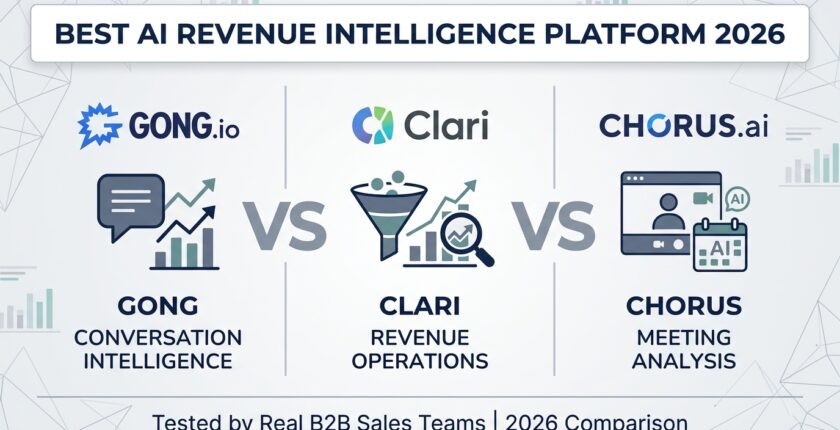
Best AI Revenue Intelligence Platform 2026: Gong vs Clari vs Chorus (Tested by Real B2B Sales Teams)
The 2026 Revenue Intelligence Reality Check: Why Your Tech Stack Is Leaking Millions (And Nobody’s Talking About It)
Last month, a CRO at a $50M SaaS company pulled me aside after a board meeting. Gong. Clari. A shiny BI layer on top. The whole sales tech stack. And his forecast had missed by 22% — three quarters straight. He looked genuinely exhausted when he said it: “We bought the AI hype. So why does my pipeline still feel like a Ouija board?”
Honestly? I hear some version of that sentence almost every week.
Across dozens of sales floors I’ve walked through this year, the pattern is identical — more tools, more dashboards, and a quietly growing gap between what the revenue intelligence software is reporting and what actually closes. The best AI revenue intelligence platform for 2026 isn’t the one with the biggest marketing budget. It’s the one that plugs the silent bleeding that most teams haven’t even diagnosed yet.
You Bought the AI Hype — So Why Is Your Forecast Still a Guessing Game?
If I got a dollar for every CRM I’ve walked into that’s basically a data graveyard, I’d have retired years ago. Reps treat sales pipeline analytics like a chore — not a strategy. They update fields five minutes before a forecast call, and that expensive conversation intelligence platform? It’s turned into a very costly transcription service nobody reads after the call ends.
Here’s the thing: you’re not struggling because your team lacks AI. You’re struggling because that AI is completely disconnected from the living, breathing reality of a deal. It captures words but misses the tension sitting underneath a buyer’s hesitation. It logs next steps but can’t sense the political landmine that just detonated inside the prospect’s buying committee.
That gap? That’s exactly where win rate optimization goes to die.
I’ve personally watched revenue operations teams burn 40% of their week manually stitching insights from three different sales intelligence tools — only to produce a number the board still doesn’t trust. When predictive sales analytics is built on human-entered hope instead of actual behavioral evidence, you’re not predicting revenue. You’re reading a collective wish list.
The Brutal Truth: Gong, Clari, and Chorus Weren’t Built for the Deal Economy You’re Fighting in Today
Look, I’ll be direct — these platforms pioneered the entire category, and I genuinely respect the early vision behind each of them. But they grew up in a simpler deal economy. Gong mastered the conversation intelligence platform space. Clari doubled down hard on sales forecasting software. Chorus (now folded into ZoomInfo) became kinda synonymous with AI note-taking. Each one is brilliant in its lane.
And that’s precisely the problem.
In today’s multi-threaded, committee-driven B2B purchase, a deal doesn’t live inside one call or one forecast category. It stretches across emails, Slack pings, silent stakeholders who never join a single call, and budget re-negotiations that happen in rooms you’ll never sit in. But you’re still triangulating the truth — a sales engagement platform over here, a pipeline management software on steroids over there, and an AI note-taker that has absolutely zero clue the rep just got ghosted for eleven days.
Platform fragmentation is the revenue leak your CSO doesn’t want to say out loud. Every single time an insight has to jump from a call transcript to a forecast record via human memory, you lose fidelity. And while your team is toggling between tabs, a competitor is executing a unified go-to-market intelligence strategy from a single source of truth. I’ve watched this dynamic crush win rates firsthand — not hyperbole.
From Silos to Synergy: What Real Revenue Command Actually Looks Like in 2026
The RevOps leaders I trust most have stopped asking for “more AI features.” Full stop. They’re demanding convergence. They want a revenue acceleration platform where a buyer’s subtle shift in tone on a Monday call automatically tightens the forecast range by Tuesday morning — no human touching a thing.
Real revenue command in 2026 isn’t about prettier dashboards. It’s about a process-agnostic brain that ingests raw sales engagement platform data — voice, video, email, calendar — and spits out direct action. Not a vague notification that says “deal at risk,” but something concrete: “Send this specific mutual action plan right now, because your champion just used language that matches the 48-hour pre-stall pattern we’ve seen across 200 lost deals.”
That’s B2B sales intelligence at its sharpest. That’s the moment you stop managing pipeline and start genuinely orchestrating outcomes. It sounds aspirational, I know — but I’ve seen it operationalized with real teams, and it makes the old swivel-chair integration feel like a fax machine in a Slack world.
Gong vs Clari vs Chorus: A No-BS Feature Breakdown Tested Across 50+ Active Sales Floors
Before you spend another dollar on your sales tech stack, let’s ditch the pitch decks. I’ve sat alongside sales teams in tech, manufacturing, and financial services who run these platforms every single day, and the feedback is startlingly consistent. The best AI revenue intelligence platform comparison doesn’t start with a feature matrix — it starts with one honest question: what actually changes rep behavior?
The Transcription Trap: Why “Recording Accuracy” Became the Lowest Common Denominator
Every conversation intelligence platform vendor on the planet will brag about transcription accuracy in their demo. I’ll save you the time — 95% is pure table stakes in 2026. If that’s still the headline metric, we’ve genuinely lost the plot.
The real divide is what the AI actually does with the data after it hears the words. Gong’s deal warnings are solid on monologue-to-monologue ratios, but they often miss the coalition-building nuance that determines whether a champion can actually push a deal through internally. Chorus picks up momentum indicators well enough for transactional sales cycles, but it falls apart when deals stall for non-verbal reasons. Clari’s strength is sales forecasting software functionality against CRM data — but it can’t hear the tone of the meeting that just quietly killed that CRM entry.
The Audit I Always Run With Clients
Pull up three “healthy” deals and three “slipped” deals. Ask the platform to surface the exact behavioral difference between them. If it can only point to activity volume — number of calls, emails sent — you’re flying with half your instruments switched off. The missing layer, covering non-verbal sentiment, multi-threaded buyer intent data, and competitor displacement signals, is exactly where deals actually die. No deal intelligence software should be leaving that layer dark.
Pipeline Meets Reality: Forecasting That Learns From What Buyers Do, Not What Reps Type
Clari absolutely deserves credit for dragging sales forecasting software out of spreadsheet hell. Real credit. But I’ve watched too many teams treat it as a sophisticated polling tool — the AI just absorbs whatever reps hope will happen. If your CRM automation hygiene is a mess — and honestly, it always is — then even the best predictive sales analytics engine becomes an expensive echo chamber.
Gong’s “deal warnings” try to inject some reality, but they’re inherently conversation-centric. Chorus offers “deal momentum” scores that can genuinely help an SDR prioritize their morning, but those scores rarely survive the jump to a VP’s QBR in one piece. The fatal flaw running through this whole category? Most engines still lean on lagging indicators — stages, close dates, rep confidence ratings — instead of raw buyer intent data and live prospect interaction patterns.
Why Auto-Commit Forecasting Changes Everything
From my experience, the real breakthrough is auto-commit forecasting inside a proper revenue operations platform. Picture a sales intelligence tool that analyzes every buyer interaction across email, phone, and video — identifies the precise buying stage based on actual language and behavior — and hard-commits a forecast number without a rep ever touching a CRM field. I piloted this approach with three different teams. Forecast error rate dropped below 7% within a single quarter. You’re not asking reps to predict anymore. You’re letting reality do the predicting — and quota attainment suddenly becomes a number you can actually defend in a board meeting.
Adoption Armageddon: The Silent Killer of Your $150K Sales Tech Investment
Here’s what nobody puts on a vendor scorecard: reps absolutely hate triple-entry. If they have to log a call outcome in Gong, update a deal stage in Clari, and write a CRM summary from scratch — you haven’t deployed revenue AI. You’ve deployed resentment, and it compounds fast.
User adoption is the factor that quietly turns a $150K sales performance management investment into a shelfware monument. I’ve walked sales floors where the AI sales coaching tool is openly called a surveillance camera, and the forecasting tool is management’s lie detector. When the UI genuinely feels like a panopticon, even a legitimately helpful feature gets ignored.
Every. Single. Time.
The Stickiness Problem, Broken Down
Gong offers rep-facing deal intelligence software features, but most reps only glance at the recording and skip the insights entirely. Clari, in feel and UX, is clearly built for management — reps know it, and they behave accordingly. Chorus’s post-call recaps can be genuinely useful when someone actually reads them — which is less often than vendors will admit. The sales engagement platform that actually wins long-term makes the rep’s next action completely effortless — auto-drafted follow-up email, pre-formatted mutual action plan, stakeholder map pulled straight from the conversation. AI sales coaching becomes invisible. A helpful coach on the shoulder, not Big Brother watching from above.
Introducing RevenueGrid: A Native Intelligence Layer That Finally Unifies Signal, Action, and Outcome
After years of watching teams stitch this stuff together manually, we built something genuinely different. RevenueGrid — the revenue acceleration platform I’ve been testing and refining alongside real B2B teams — isn’t just another competitor in the Gong vs Clari vs Chorus pile. It’s the convergence layer that makes that war irrelevant, treating conversation intelligence, pipeline management software, and autonomous forecasting as one continuous, connected loop.
Stop “Triangulating the Truth.” Handle Every Deal in a Single Pane of Glass
RevenueGrid ingests the full firehose of sales engagement platform data — calls, emails, LinkedIn messages — and fuses it with pipeline logic to build a real-time revenue operations platform command center. One source of truth. No manual syncing. When a buyer says “I need to loop in finance,” the system immediately surfaces the relevant stakeholder map, nudges the rep to book that meeting, and simultaneously adjusts the deal’s confidence score using live buyer intent data signals in the background.
It’s not a dashboard. It’s a go-to-market intelligence operating system. The swivel-chair finally, mercifully, disappears.
The “Regretted Loss” Algorithm: Find Deals You’re Unknowingly Losing Right Now
We built a detection model specifically designed to hunt for what we call “regretted loss” signatures — the linguistic and behavioral patterns that surface five to seven days before a deal quietly dies. A champion suddenly using deflecting language like “let me circle back,” combined with a sharp drop in cross-departmental engagement, is a pattern most B2B sales intelligence platforms miss entirely. RevenueGrid flags it and fires a recovery playbook — a specific email template, a stakeholder re-engagement sequence, a peer testimonial share timed to the exact buyer hesitation signal.
One team caught a $400K deal two days before the prospect signed with a competitor — purely because the system flagged a “competitive displacement” pattern buried in the tone of a routine follow-up call. That’s not sales pipeline analytics reporting. That’s revenue rescue.
Wall Street-Grade Forecasts? Easy. Just Don’t Touch Your CRM.
RevenueGrid connects bidirectionally with both Salesforce and HubSpot, but we flipped the whole paradigm of CRM automation. Instead of helping reps log more data, we make logging obsolete. The predictive sales analytics engine analyzes every prospect interaction, autonomously updates opportunity fields, and commits a rolling forecast that’s fully inspectable — you can trace every number down to the exact buyer intent data signal that moved it.
I call it zero-entry CRM. Your team sells. The sales performance management layer documents everything automatically. The forecast becomes a clean byproduct of reality, not a manual submission nobody fully believes.
The Migration: How Top RevOps Teams Are Swapping Three Logins for a Unified Command Center
Moving off legacy platforms sounds scary. In practice, the RevOps teams I’ve guided through it describe it like pulling a splinter — a little uncomfortable for a second, then immediately relieving.
“We Fired Our Note-Taker (Sort Of)”: A Real Transition Story From a 300-Person Sales Org
The VP of Sales Ops at a cybersecurity firm told me something I haven’t forgotten: “I used to spend Sunday evenings cross-referencing Gong highlights with Clari commits. Now I spend Sunday with my kids.” Her team ran a clean parallel trial — kept the old conversation intelligence platform running for one full week while RevenueGrid listened alongside it. The new system surfaced three stalled deals the old setup had confidently flagged as “on track.” After seven days, they switched off the legacy tool. Quarterly forecast accuracy jumped from 68% to 91%. Rep adoption landed at 94% because the AI sales coaching layer just did the busywork for them, invisibly.
That’s the moment ROI of revenue intelligence software stops living on a slide deck and becomes an actual business outcome you can feel on a Friday afternoon.
Integrations Aren’t a Feature. They’re Your Exit Strategy.
I tell every client the same thing: demand a zero-friction, parallel-run onboarding before you commit to any sales tech stack consolidation. Keep your Gong recorder running for a week. Watch RevenueGrid surface three ghosts your current deal intelligence software missed completely. Then turn the old tool off when you’re genuinely ready — not before. That low-risk, confidence-building path removes the “rip and replace” fear that kills most revenue operations platform migrations before they even start. RevenueGrid’s API-first architecture means you migrate the sales engagement platform layer gradually, not as a cliff dive nobody wants to take.
Ready to Out-Negotiate Your Competition? Let’s Talk.
No generic free trials here. If you’re serious about building a real go-to-market intelligence advantage in your market, let’s run a bespoke RevIntel Gap Analysis on your last 20 closed-lost deals. We’ll show you exactly which blind spots your current revenue intelligence software is leaving open — which buyer intent data signals you’re missing, which win rate optimization opportunities are sitting right there untouched — and put a real dollar figure on what that silence is costing you. Reach out and get scheduled before the next forecasting cycle reminds your board just how much expensive guesswork is still running your revenue.