
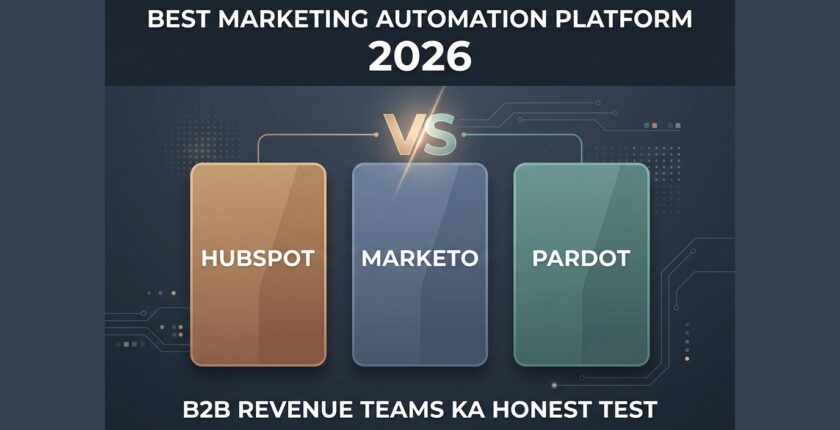
HubSpot vs Marketo vs Pardot: Which B2B Marketing Automation Platform Actually Closes Revenue?
Is Your Marketing Automation Platform Secretly Sabotaging Revenue in 2026?
Last quarter, I was barely two sips into my espresso when a revenue VP leaned across the table with that look. You know the one. “We keep pouring leads into the top of the funnel,” he said, “but our close rates are dropping. The automation is supposed to help. Right now it feels like it’s actively working against us.”
I just nodded. Because honestly? I’ve heard some version of that exact sentence — different coffee shops, different cities, same defeated look — more times than I can count over seven years of hands-on marketing automation consulting.
This isn’t rare. It’s kinda the quiet epidemic inside B2B revenue teams right now. You bought the platform to accelerate pipeline. You had visions of a clean, humming demand generation machine running on autopilot. Instead, you’re spending more time untangling sync errors and chasing misrouted leads than you are celebrating wins. The uncomfortable truth? Most teams are genuinely fighting their own software.
What if the marketing automation platform you trust to fuel pipeline is the very thing blocking your reps from closing?
That friction is everywhere, once you know what to look for. It shows up as a leaky B2B funnel where automation passes leads nobody asked for, while real opportunities collect dust. It shows up as revenue team alignment so fractured that marketing pops champagne over MQL targets while sales watches SQL (sales qualified lead) conversion rates quietly tank. It shows up in a MAP that technically doesn’t break CRM integration — yet still manages to duplicate contacts and vaporize engagement history in a single sync error.
Sound familiar? You’re already sabotaging revenue. Not scaling it.
So here’s what I’m doing. An honest, no-affiliate-nonsense marketing automation software comparison — nobody paid me to write this. After seven years in this field, I’ve watched platforms make teams rich and make teams miserable. I know the difference.
The 2026 Stakes No B2B Team Can Afford to Ignore
Let’s talk about what’s really on the line when you make the wrong call. Not just license fees. I mean the total cost of ownership (TCO) that quietly bleeds out through silos, ops burnout, and campaigns that launch three weeks late because a workflow decided to die at the worst possible moment. It also means a measurable hit to your customer acquisition cost (CAC) — because every week your MAP misfires, your pipeline stalls, your deals slow, and your CAC balloons in ways that eventually show up in a very uncomfortable board meeting. Money hemorrhaging in slow motion. Nobody frames it like that, but that’s exactly what it is.
Too many leaders get fixated on HubSpot vs Marketo pricing 2026, or per-user costs for Pardot Advanced. They’re staring at sticker prices while skipping the real weight — how many hours your marketing ops person burns patching together revenue attribution reports, or the deals sales loses because a scoring model quietly went stale.
And here’s what most vendor comparisons flatly refuse to say: in 2026, revenue operations (RevOps) isn’t a buzzword anymore. It’s the actual infrastructure your MAP needs to plug into. If your marketing automation platform can’t align with your RevOps motion — connecting marketing, sales, and customer success into one coherent revenue engine — you’re building on sand. Full stop.
Your B2B demand generation engine? The one your team spent months building? It runs entirely on your MAP firing correctly at every stage, every handoff, every nurture sequence. One misconfigured step and the whole thing leaks.
Meanwhile, buyer expectations are a completely different animal in 2026.
A prospect now expects a journey as intuitive as their Netflix queue. Not an exaggeration — that’s genuinely the bar. If your marketing automation platform is still firing generic email blasts off static lists, you’re not just failing to convert. You’re training your market to ignore you. A misconfigured MAP doesn’t just underperform. It actively creates churn and quietly hemorrhages the demand generation budget you worked hard to justify.
HubSpot vs Marketo vs Pardot — The Revenue Team’s Unfiltered Showdown
This isn’t a feature matrix from a vendor demo. Think of it as the “who stays standing in your martech stack” test, measured in actual revenue outcomes. We’re evaluating each platform through the lens of what a B2B revenue team actually needs day to day — speed to pipeline, clean handoffs, and minimal ops burden.
HubSpot Marketing Hub — The Revenue Accelerator That Demands Process Maturity
HubSpot is fast. Full stop.
It’s the darling of growth-stage companies that needed to launch campaigns, like, yesterday. A HubSpot Marketing Hub enterprise demo always lands impressively — polished, intuitive, genuinely easy to navigate. But here’s the thing nobody says in the demo room: fast without process doesn’t create momentum. It creates chaos.
When you’re evaluating HubSpot vs Marketo pricing 2026, HubSpot’s entry point feels approachable. Almost suspiciously so. That’s because it pulls you in with free CRM integration, then slowly — almost elegantly — escalates costs through add-ons. Transactional email. Custom reporting. Dedicated IPs. That “affordable” package gets eye-watering fast once you need the tools that actually drive revenue. I’ve personally watched teams wince at the jump from Professional to Enterprise, especially when they realize they also need Sales Hub Enterprise just to unlock the custom objects their revenue model actually requires.
The lead nurturing automation inside HubSpot is genuinely intuitive once your workflow logic is clean — automated sequences, behavior-triggered emails, smart content personalization that actually adapts to buyer stage. It’s all there. But “intuitive” and “powerful” are only the same thing when your team knows exactly how to use it.
HubSpot’s revenue-centric strengths are real, though. Deal-based workflows tie marketing activities directly to pipeline. Conversational bots connect chat to CRM records automatically. Native payment links let sales close inside an email. The best HubSpot implementations I’ve ever seen happened inside revenue teams that had already nailed their sales process and were simply amplifying it. Their pipeline velocity was already healthy — HubSpot just accelerated what was working.
The Hard Truth About HubSpot
If your process is still a scribble on a whiteboard, HubSpot will just make the mess louder. And if HubSpot’s pricing is already making you wince before you hit the Professional tier, you’re not crazy for researching HubSpot alternatives 2026 — there are genuinely competitive options worth evaluating before you sign anything.
Marketo Engage — The Enterprise Fortress That Won’t Forgive an Undersized Ops Team
Marketo is a precision engine. Genuinely.
It’s the platform you graduate to when your B2B buying cycle spans six months, involves seven stakeholders, and demands attribution reporting your CFO actually trusts — not just thinks sounds right. Enterprise marketing automation ROI comparisons almost always favor Marketo in complex environments, and the revenue intelligence capabilities are legitimately best-in-class. Its multi-touch attribution modeling doesn’t just tell you what happened in the funnel — it tells you why, with the granularity that can actually shift budget decisions at the leadership level.
But I always tell my clients the same thing: “Marketo is a precision engine. Hand it to a team of one, and it stalls.” You need at minimum a dedicated marketing operations automation professional putting 10+ hours weekly into maintenance — syncing programs, auditing data, tweaking scoring models. If you’re already searching “Marketo consultants near me,” that’s a tell. Your internal bandwidth is already stretched thin.
What Marketo Actually Gets Right
The advanced lead scoring, B2B demand generation orchestration, and lead nurturing automation depth can differentiate between a genuine hand-raiser and a tire-kicker across multiple touchpoints. That’s rare and genuinely valuable. Its native ABM scoring helps sales prioritize accounts — not just leads, actual accounts — which hits pipeline velocity in ways most platforms simply can’t replicate. For large enterprises with a mature marketing technology stack already built out, Marketo often is the right fortress.
But if your team is lean and you’re expecting “set it and forget it”? You’ll be fighting the platform before Q1 is over. Guaranteed.
Pardot (Marketing Cloud Account Engagement) — The Salesforce-Loyal Choice That Often Confuses Revenue Teams
Pardot’s pitch is clean: the deepest Salesforce CRM integration on the market. For a revenue team that essentially lives inside Salesforce, that’s genuinely seductive.
But here’s the analogy I keep coming back to — running Pardot without a Salesforce architect is like driving a stick shift in a Formula 1 race. Impressive setup. Until you stall on lap three.
When the Pardot vs HubSpot Debate Actually Gets Interesting
The Pardot vs HubSpot for B2B revenue teams debate almost always boils down to one question: how married are you to Salesforce? Pardot’s real differentiator is its Einstein AI scoring, which pulls directly from your CRM data to surface real buying signals — not vanity signals. Combine that with deep B2B lead management, solid lead nurturing automation sequences, and Salesforce Flow automation, and you’ve got a powerful demand generation engine for teams already heavily invested in the Salesforce ecosystem.
But that loyalty becomes a trap fast. If you’re running a non-Salesforce CRM instance, or if your marketing team wants true multichannel automation — SMS, dynamic web personalization, native social — Pardot starts to creak. When you’re comparing Pardot Advanced vs Premium, the jump isn’t just about features. It’s about needing a full-time admin to handle the complexity, which hits your TCO hard, inflates your CAC, and quietly destroys pipeline velocity while everyone figures out what broke.
I’ve walked into companies where Pardot was fully set up, technically live, properly embedded in the martech stack — and the revenue team had quietly abandoned it. Lead assignment rules kept breaking. Nobody knew how to fix them. Nobody had time to learn. So it sat there, running in the background, doing almost nothing useful. Not a horror story. Just a very expensive shrug.
Beyond Features — The 3 Real Battlegrounds Where Revenue Leaders Actually Judge a MAP
Stop reading product comparison charts. In 2026, revenue leaders don’t judge marketing automation software by its feature list. They judge it by three battlegrounds that directly hit the bottom line.
Battleground 1: Time-to-Revenue and Pipeline Velocity
How fast can you go from “campaign live” to “sales accepted opportunity”? Fixing a leaky B2B funnel with automation means your MAP should compress pipeline velocity — shrinking the lag between engagement and handoff, not creating more lead scoring black holes. If a lead takes 14 days to route after downloading a demo, the platform is literally costing you deals. And every extra day of unnecessary delay compounds directly into CAC inflation that eventually hits the P&L.
Battleground 2: Data Integrity Between Marketing and Sales
You need a MAP that doesn’t break CRM integration — but also one that doesn’t duplicate contacts, overwrite field values, or vaporize activity history when a sync error rolls through. When sales stops trusting the lead record, they stop looking at it. MQL becomes a running joke. SQL rates floor out. And everything your B2B demand generation motion built quietly disappears.
Battleground 3: Internal Team Friction and Marketing Operations Automation Churn
Honestly, this is the one nobody talks about enough. Ops burnout is the silent budget killer. When your marketing operations automation requires constant babysitting, you lose your best ops talent — and with them, all the institutional knowledge you’d actually need to optimize anything. Quick gut-check: when did you last celebrate your automation instead of troubleshoot it? If you can’t remember, that’s your answer right there.
The Decision Trap That Even Smart VPs Fall For (And How to Outsmart It)
Most VPs start their evaluation completely wrong. They check analyst quadrants, hear a competitor switched to Marketo, and panic. That’s the trap — buying based on someone else’s revenue model, not yours.
Here’s a hypothetical that illustrates this painfully well. Imagine a fast-growing SaaS company with 30-day sales cycles and largely touchless sign-ups. They go through a full Marketo implementation because an enterprise competitor uses it. Their deal complexity doesn’t need it. Their ops team can’t maintain it. Their martech stack now has an $80K/year precision engine running at 15% capacity. Six months later, they’re back at square one — minus a six-figure investment, several months of lost pipeline velocity, and a CAC that quietly doubled. Impossible? Nope. I’ve seen it play out almost exactly like that.
Your SaaS pipeline with 30-day cycles behaves completely differently from a manufacturing firm running an 18-month, multi-stakeholder deal. A MAP — and the broader marketing technology stack built around it — that thrives in one environment will strangle the other.
That’s why B2B marketing automation best practices in 2026 start with a revenue-model-first approach. Before evaluating sales enablement software, demand generation tools, or any MAP, map your own revenue motion first. Average deal size. Sales cycle length. RevOps maturity. Marketing ops headcount. That self-awareness stops you from being swayed by a slick product tour built for someone else’s business entirely.
Not “which platform is best?” — but “which platform fits how we sell?”
Meet Your 2026 MAP Decision Matrix — A Revenue-First Matchmaker
We built something for exactly this problem. It’s called the RevenueStack Matchmaker. No biased vendor demos. No affiliate angles. Just mathematical fit, built from data across 400+ real B2B deployment reviews.
How It Works (And Why 60 Seconds Is All It Takes)
Six data points: average deal size, sales cycle length, CRM in use, team size, marketing ops maturity, and whether ABM is central to your motion.
That’s it.
The engine compares your profile against real-world performance patterns — where each platform thrives and where it cracks under pressure. You get a personalized battlecard: platform score, predicted operational friction, and a 5-year TCO projection covering not just licenses, but the hidden costs — overtime hours, external consultant spend, the CAC bleed that never shows up on a vendor slide. We don’t sell software. We sell clarity.
Real Outcomes from Revenue Teams Who Stopped Guessing
A 50-person SaaS firm came to me convinced they needed “the enterprise leader.” Their TCO projection told a very different story — $47K in unnecessary spend over five years on add-ons and ops maintenance for a platform they’d fundamentally underutilize. They switched to a tight-fit MAP instead. Their B2B demand generation stayed consistent. Pipeline velocity improved. Their ops person actually loves it now. Time-to-revenue dropped 22% in the first quarter.
Not a fluke, you know. That kind of outcome is repeatable when the fit is right. Join 200+ B2B leaders who ditched analyst grids for a data-driven decision. When to switch from Pardot to HubSpot — or the other way around — becomes completely obvious once you see the friction forecast, not just the feature list.
Your Next Step — The Fair Fight Assessment
Tired of watching your revenue team troubleshoot workarounds while a better-fit MAP sits unnoticed on a comparison spreadsheet?
Stop accepting marketing automation as a necessary headache. It’s supposed to be your best revenue operations (RevOps) alignment tool — not the daily source of friction, finger-pointing, and quiet dread every time something breaks in your martech stack.
Start your honest match. Get your 2026 B2B MAP Battlecard — an instant, personalized report showing which marketing automation platform wins for your revenue motion, backed by real data and completely free from vendor spin. No email spam. Enterprise-security reviewed.
Reveal My Ideal Stack →