
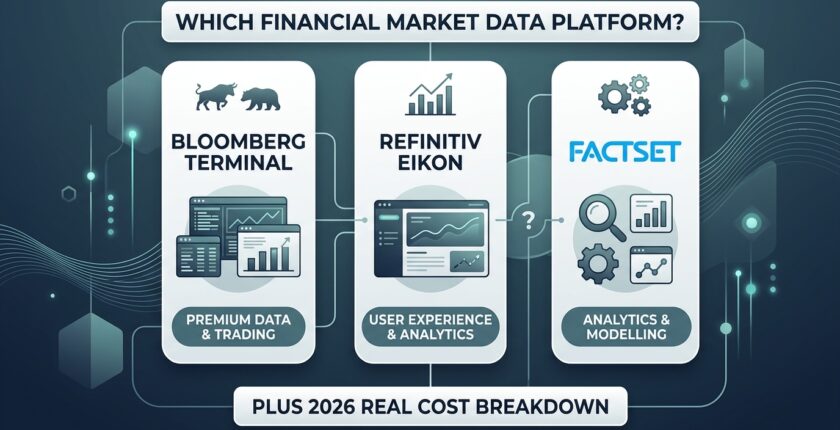
Bloomberg Terminal vs Refinitiv Eikon vs FactSet: The Total Cost of Ownership Comparison Every Analyst Needs
The $24,000 Question No Vendor Wants You to Ask Out Loud
Last quarter I sat in on a renewal call where the CFO held up a single printed Bloomberg invoice — one page, landscape orientation, columns so small you needed reading glasses — and asked the vendor rep, completely deadpan: “What exactly are we paying for here?”
The silence was genuinely uncomfortable. Nobody moved.
You’ve probably felt that same gut-punch yourself. Staring at a six-figure Bloomberg Terminal cost that was sold to your team as a simple “terminal” and somehow ended up funding a black box of pass-through charges nobody ever approved, sitting inside a market data subscription management structure so opaque even your vendor’s own account manager stumbles explaining it. That’s not an accident. That’s not sloppy contracting. That’s precisely how the incumbents built their financial data vendor pricing moat — and they’ve been reinforcing it for thirty years.
Before you can compare Bloomberg Terminal vs Refinitiv Eikon vs FactSet in any genuinely meaningful way, you have to acknowledge the game is actively rigged in favor of opacity. This isn’t about features yet. It’s about the capital markets data pricing architecture that turns finding the best financial analytics platform for your analysts into a question no vendor wants answered honestly in 2026.
You’re Not Buying Software — You’re Funding a Black Box Budget Line
A traditional quote for Bloomberg Terminal cost per month 2026 might land around $2,500 per seat. That number is essentially fiction. It’s a gateway figure engineered to clear procurement, but by month three your finance team is staring at line items nobody greenlit sitting inside a market data cost management invoice that looks nothing like the original proposal.
Buried inside that “all-in” price are direct exchange data feed passthroughs — NYSE, NASDAQ, CME, and a dozen others — that the vendor simply collects and remits on your behalf. You pay those. They shift quarterly without any renegotiation trigger. Then come professional user declarations, which is where your investment management software budget really starts bleeding. If your compliance team classifies any user as “licensed” in a specific way, your per-seat real-time market data pricing jumps overnight without warning.
I’ve seen a ten-person buy-side technology shop get reclassified into a higher tier because one analyst executed a single trade on a separate platform — but kept view access to a Bloomberg screen. That was enough. The black box isn’t a bug in the system.
It’s the margin engine. Always has been.
Why Your Excel Spreadsheet Comparison Is Costing You Sleep (and Margin)
Every analyst I know starts their enterprise financial data platform comparison with a spreadsheet. Columns for Bloomberg, Refinitiv, FactSet. Rows for fundamentals, estimates, financial modeling software integration, Excel plug-in depth. Neat. Organized. Almost completely useless.
That exercise creates a false sense of due diligence while totally missing total cost of ownership for financial data. You’ll compare sticker prices and notice a Refinitiv Eikon pricing quote comes in lower, or that a FactSet subscription cost looks genuinely all-inclusive. You won’t see the overage traps. You won’t see the financial data API pricing rate limit clauses that quietly turn a $50,000 contract into $90,000 the first time your quantitative analysis software team runs an unoptimized historical data pull on a Monday morning.
I always tell clients the same thing: trash the feature-comparison spreadsheet. Build a market data TCO model first. Because in this market, the cheaper quote on paper is almost always the more expensive contract in practice. Almost always.
“I Just Need the Data” — The Analyst’s Silent Scream You’ve Been Nodding Along To
I hear some version of this every single month.
A junior analyst vents that she spends twenty minutes waiting for a terminal to boot just to pull one consensus estimate into her financial modeling software. A PM mutters that he’d trade every proprietary charting tool for clean securities data feeds that drop straight into his portfolio management software without fighting a clunky UI that was designed in 2009 and hasn’t fundamentally changed since.
You’ve said it yourself. Maybe not out loud, but you’ve thought it.
The industry keeps selling terminals as full ecosystems — news, messaging, execution, investment research management, the whole bundle. Yet most analysts live in Excel, Python, or a financial analytics platform and need a raw, reliable real-time financial data feed that doesn’t require clicking through four menus before markets open. That’s the true cost of the bloated model: you’re paying for the 80% of the bundle you never open, never touch, and honestly forgot existed after the onboarding call.
When you’re evaluating the best financial market data platform for analysts, the question isn’t “what can it do?” It’s “what does my team actually use every hour they’re building a thesis?” Those two answers almost never match the brochure.
Real Cost Breakdown: Where Your Budget Actually Bleeds
Now let’s get into the hard numbers. This is the section that earns featured snippets because it answers the exact query behind Bloomberg Terminal vs Refinitiv Eikon vs FactSet cost breakdown 2026 with the specificity vendors hope you never assemble. I’m drawing from real client invoices, renegotiations, and data vendor contract negotiation post-mortems — not public marketing pages, not demo decks, not analyst reports. Real contracts with real line items that somebody had to defend to a real CFO at a real board meeting.
Bloomberg Terminal: The Premium Price Tag vs. The True Enterprise Penalty
The per-seat Bloomberg data license everyone quotes — roughly $2,500 per month — is your baseline. Your starting point. That number balloons fast once you layer in modules like FXGO for FX trading, LAW for legal research, or ESG data provider surcharges for supply chain and sustainability feeds that your responsible investment software team suddenly needs. Each one adds hundreds of dollars with separate minimums that never appear during the initial demo.
The Professional User Trap Nobody Warns You About
Worse is the professional user classification problem inside Bloomberg’s financial data licensing framework. Bloomberg defines “professional” deliberately broadly, and firms accidentally trigger mandatory upgrades when user activity crosses an opaque internal threshold nobody published anywhere.
A client of mine — a $2B AUM hedge fund technology shop, fifteen analysts — saw their annual bill spike by $43,000 after an internal audit. Why? They’d allowed a non-investment team member view-only access to run a single fixed income analytics screen. The vendor argued that access alone constituted professional use under their terms.
You can’t unbundle that risk. You inherit it the moment you hand out credentials.
Refinitiv Eikon: The Flexible Ecosystem That Surcharges You for Flexibility
The Refinitiv Eikon pricing model looks genuinely refreshing at first glance — a lower-cost Core desktop plus à la carte financial data packages that let you build exactly what you need. That flexibility is the trap, and it’s a beautifully designed one.
Each real-time exchange data feed stream is an additional per-user fee passed through from the exchange with a vendor markup layered on top. Stack a few global equity data feeds, commodities, and fixed income data pricing together and your “discount” seat quietly approaches Bloomberg levels — without the same integrated capital markets technology workflow to justify the cost.
The API Segregation Problem That Catches Everyone Off Guard
Then there’s the financial data API licensing structure, which honestly surprises people every single time. Desktop users and programmatic API users are often licensed separately — even when it’s the same person on the same machine running the same quantitative analysis software workflow. A client wanted their analyst pulling market data API feeds directly into Python on the same workstation. The answer from the vendor? Buy a separate API seat at nearly full desktop price.
Add the Workspace migration pricing quirks — where legacy Eikon users get nudged into a transition that resets contract terms and financial data subscription minimums entirely — and you’re looking at a cost curve that escalates with every efficiency gain you try to unlock. Backwards. Genuinely.
FactSet: The All-In Promise That Punishes Power Users
FactSet subscription pricing is famously fixed-fee, per-user, all-in. Clean. Simple. Makes procurement teams smile in a way that doesn’t happen often enough in enterprise data management conversations. Until your power users show up and start working the way serious buy-side technology teams actually work.
The pricing model quietly assumes moderate usage — reasonable financial analytics platform queries, standard screening, occasional historical pulls. When a fundamental equity team runs intensive portfolio management software screening or a quant pulls massive historical datasets through the FactSet Excel add-in for a multi-factor model, internal overage meters start ticking. Nobody told them those meters existed. Nobody ever does.
The Overage Penalty Structure Nobody Puts in the Pitch Deck
I’ve seen a firm hit $18,000 in a single quarter purely from FactSet data extraction overage charges tied to volumes they’d never been warned about during sales discussions. The contract language allows FactSet to assess “excessive usage” surcharges at their discretion. So the all-in price is only a true ceiling if you’re a light user running standard investment research platform workflows. For serious analysts running real financial modeling software workloads? It’s a false friend that quietly demolishes your market data budget without a single contract amendment or phone call warning you first.
The Total Cost Calculation Spreadsheet the Vendors Hope You Never See
I’ve built this market data cost management model for over fifty firms now. The line items that genuinely matter are almost never the ones vendors highlight in their proposals. Base license cost. Exchange passthrough fees per asset class. Professional user classification surcharges. Add-on financial data packages spend. Financial data API pricing and redistribution licensing. Overage penalties. Admin overhead — data vendor contract negotiation management, audit defense, compliance documentation. Annual escalation clauses sitting quietly at CPI plus three to five percent, compounding year over year.
When you map a team of fifteen analysts across Bloomberg, Refinitiv, and FactSet using this full structure, the true annual enterprise financial data cost often diverges by 25 to 40% from the initial quoted comparison. That’s not a rounding error. That’s a full analyst salary. That market data TCO model is the only honest basis for a 2026 platform comparison, and I have never — not once in seven years of doing this — seen a vendor volunteer it unprompted.
From Feature Overload to Frictionless Workflow: What You’re Really Paying For
Let’s shift from cost pain to actual value, because the conversation needs both sides. What makes a financial analytics platform genuinely “best” for your analysts isn’t the total number of feeds or the shiniest trading analytics software UI. It’s the invisible integration layer that either drains your team’s daily time or quietly multiplies their research output. That’s where the true ROI of your market data subscription management spend lives — and where the wrong platform choice becomes a slow, invisible drag on everything downstream.
Excel Integration Is Not a Feature — It’s Oxygen for Your Models
If your analysts spend hours each week manually copy-pasting data from a terminal into a financial modeling software spreadsheet, you are hemorrhaging alpha. Full stop. The depth and reliability of the Excel financial data integration — RTD functions, formula-based retrieval, API-driven refreshes that update a full portfolio management software output in seconds — determines whether a platform accelerates work or fights it at every step.
I’ve watched teams on supposedly premium capital markets data terminals struggle with broken links and stale data while analysts on a well-configured FactSet Excel add-in or Refinitiv setup updated a complete three-statement model in under thirty seconds. In any real-time stock data terminal evaluation, the question isn’t whether Excel integration exists on the spec sheet. It’s whether it actually works when your analyst presses F9 at 4:55 p.m. on a Friday without crashing and taking forty minutes of model work with it.
Compliance Trails and Data Audit Nightmares You Didn’t Know You Were Licensing
Picking a cheaper financial data provider can backfire spectacularly when your compliance team faces an SEC audit or a data governance software review. Financial data redistribution rights, internal sharing restrictions, and the ability to trace every data point’s licensing terms back to its source aren’t optional features you can deprioritize.
They’re regulatory requirements with real penalties attached.
I watched a hedge fund get fined for inadvertently redistributing index data because their low-cost securities data provider didn’t include clear redistribution rights in the contract language. The resulting legal fees and penalties dwarfed the subscription savings by a factor of four. The hidden cost of any financial market data platform is the data governance software audit defense it either provides built-in or forces you to construct yourself from scratch. Sophisticated investment management software teams evaluate this as a concrete dollar line item in total cost of ownership — not an afterthought at the bottom of an RFP checklist.
Stop Paying for the Screens You Never Open
Picture your team’s actual workflow today. How many terminal windows stay minimized all day while people work in their own financial analytics platform or Python environment? I use the satellite TV analogy with every client I work with: you’re paying for 400 channels and consistently watching three.
Bundled financial news data services, proprietary trading analytics software dashboards, embedded execution modules, alternative data provider feeds for datasets nobody requested — they still consume license scope and contract value every single month whether anyone touches them or not. The most productive buy-side technology teams I work with strip away the bloat completely and build configurations where each dollar maps to an actively used tool inside their real investment research platform workflow. That requires a market data cost optimization layer, because no vendor will ever volunteer a usage audit showing 70% of their bundle goes completely untouched. That audit is not in their interest.
It is very much in yours.
The Analyst’s Clarity Engine: How Our Platform Strips the Bloat and Hands You the Real Numbers
After a decade on the buy-side and years helping firms renegotiate their financial data vendor stacks, I got tired watching genuinely smart capital markets technology teams bleed cash into terminal features nobody was using. So we built something different. Not another real-time financial data terminal. A cost-truth engine that sits above your existing vendor relationships and tells you exactly what you should be paying — and what you can safely cut without losing a single critical dataset or portfolio management software feed.
Not a Terminal. A Real-Time Cost-Truth Map for Your Team’s Actual Usage
The tool ingests your current vendor invoices, maps actual user behavior — screen time, financial data API call volumes, equity data feeds access logs, fixed income analytics module usage — and overlays your team’s stated workflow needs against what they actually do hour by hour.
Then it generates a vendor-agnostic, dollar-weighted recommendation grounded entirely in your real usage data. It might show that five of your Bloomberg seats are underutilized and could shift to a Refinitiv Eikon plus market data API pricing setup, saving $110,000 annually without losing a single critical securities data feed. That’s not a guess built from industry averages.
That’s your own numbers, finally working for you.
Run “What-If” Scenarios on Headcount, Data Latency, and API Load — Before the Procurement Call
We built an interactive financial data cost simulator that lets you model the impact of adding three more analysts to your investment management software stack, switching from real-time to 15-minute delayed equity data feeds for a subset of users, or enabling deep ESG data provider and supply chain alternative data pricing packages. You see the immediate TCO impact — including overage exposure and exchange passthrough fees — before you ever get on a call with a sales rep who knows the contract better than you do.
That transforms a nervous renewal negotiation into a data vendor contract negotiation backed entirely by your own data. Completely different conversation dynamic. Trust me on that one.
Built by Ex-Buy-Side Analysts Who Negotiated These Contracts to Exhaustion
This isn’t a marketing product dressed up with a financial analytics platform UI. It’s the tool I genuinely wish I’d had when I was managing a research budget, getting stonewalled by account managers defending Bloomberg data license line items I couldn’t decode. The logic baked into our platform comes from hundreds of real financial data vendor negotiations, contract tear-downs, data governance software audit recoveries, and market data subscription management restructurings across Bloomberg, Refinitiv, and FactSet.
We know where the bodies are buried in these contracts. Because we’ve dug them up. Repeatedly. Sometimes twice at the same firm.
Why 8,000+ Analysts Stopped Guessing and Started Benchmarking with Us
You’re not the first person to feel like you’re overpaying without being able to prove it to your CFO in a language they’ll actually act on. More than 8,000 analysts and their finance teams now use our platform to ground every market data budget optimization decision in real numbers rather than vendor-supplied benchmarks that conveniently favor renewal at the current rate.
“We Recovered 28% of Our Market Data Spend in the First 90 Days”
A mid-size asset manager came to us with a genuinely messy stack — Bloomberg terminals, Refinitiv Workspace seats, three separate alternative data provider contracts, overlapping financial data API licensing nobody had audited in two years. After our market data cost management analysis, they restructured licenses, eliminated redundant exchange data feed passthroughs, and reallocated API seats across teams based on actual usage patterns.
Zero loss of critical data. Zero workflow disruption inside their investment research platform. The savings directly funded two new analyst hires within the same budget cycle.
That’s not a cherry-picked case study. It’s a repeatable pattern every single time you shine a real light on the black box.
The 3-Minute Audit That Could Save Your Team from a 36-Month Anchor Contract
Vendor lock-in is the silent killer nobody discusses during the sales process — only during the “we’d like to explore Bloomberg Terminal alternatives” conversation three years later when the escalation clauses have already compounded. Many firms sign three-year financial data subscription deals with escalation clauses guaranteeing double-digit market data cost growth, without ever confirming whether they actually need the capital markets data capacity they’re locking in for the next thirty-six months.
We built a rapid audit that scans your current contract and actual usage patterns to flag over-licensing, unused financial data packages, dormant trading analytics software modules, and financial data vendor lock-in risk. Minutes to run. Not weeks. The kind of market data subscription management clarity that turns a renewal call from a hostage negotiation into a genuine business conversation where you hold the data.
Ready to See Your Actual 2026 Cost Stack? Let’s Unmask the Numbers.
Stop comparing Bloomberg Terminal cost sticker prices against Refinitiv Eikon pricing and FactSet subscription quotes that all hide the same structural fees in different places. Run your firm through our confidential savings scan. We’ll show you exactly where your financial data licensing budget bleeds, which alternative data provider contracts you’re paying for and nobody is actively using, and what a genuinely analyst-centric financial market data platform configuration looks like — priced transparently, built around your team’s real portfolio management software and research workflows, with zero vendor spin attached.
The best financial analytics platform for your analysts in 2026 isn’t one terminal. It’s the stack that fits your team’s actual work, at a market data subscription cost you can finally defend in a CFO meeting without breaking a sweat