
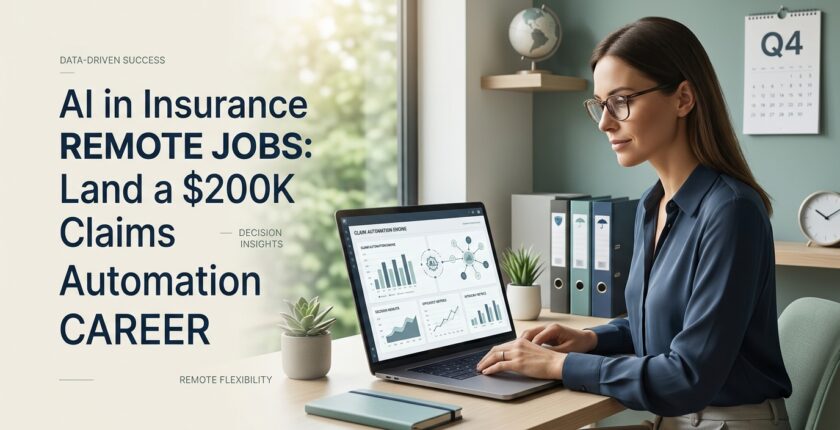
AI in Insurance Remote Jobs: The Ultimate Guide to Becoming a Claims Automation Expert
So, You’ve Heard That AI in Insurance Remote Jobs Are Exploding—But Is It Real or Just Hype?
Not long ago, a regional P&C carrier would have shown you the door if you suggested software could triage claims better than a seasoned adjuster. “We don’t need robots,” the VP of Claims would say. “We need people who can smell fraud.” That same carrier today? Fully remote, running a claims automation team, and hasn’t touched a paper claim in 18 months. The shift didn’t arrive with a press release. It happened quietly, then all at once.
If you’re skeptical about AI in insurance remote jobs, good. You should be. The internet loves shouting “this is the next big thing” right before the bubble pops. But insurance isn’t a startup playground. It’s a centuries-old machine that moves slower than a glacier — until it doesn’t. And the numbers right now are genuinely staggering. The global insurtech market is projected to sail past $150 billion by 2030, with claims automation swallowing the biggest slice of that pie. Why? Because the alternative is watching claims departments drown in their own backlog.
So no, AI in insurance remote jobs aren’t a passing fad. They’re the structural answer to a crisis that’s been quietly building for a decade. The hype sounds loud, I get it. But the signal underneath? Deafening.
Why AI in Insurance Remote Jobs Are Suddenly Everywhere (And What Changed)
Honestly, I kinda blame the pandemic. But not in the way most people think. COVID didn’t invent remote work — it just ripped the bandage off in one go. For insurance, that meant millions of claims piling up, a sudden exodus of retiring adjusters, and customers who suddenly expected everything to happen on their phone in under three minutes. The industry had two choices: collapse under the weight, or finally let AI out of the lab and into the cloud.
They chose the cloud.
And once those workflows went fully digital, where the worker sat became completely irrelevant. That’s the short version. The real story is a messy, perfect storm of three things colliding at once.
The Silent Crisis in Claims Departments That Made AI Non-Negotiable
Insiders have been whispering about this for years: claims departments are bleeding out. The average tenure of a property adjuster keeps shrinking, and the talent pipeline isn’t just dry — it’s desiccated. I’ve personally spoken with carriers who had 300 open adjuster roles and exactly zero qualified applicants for six straight months. Not exaggerating. Not even a little.
Burnout? Rampant. Leakage? Through the roof. I once saw a large auto insurer quietly paying out $12 million a year in “goodwill” settlements simply because overworked adjusters didn’t have the bandwidth to investigate subrogation potential properly. That’s not incompetence. That’s a system stretched so thin it’s see-through.
Now enter claims automation. It’s not just about cutting costs. It’s about survival. Automating FNOL, digitising medical records with computer vision, using predictive models to flag high-risk claims — these aren’t “nice-to-haves” anymore. They’re the life raft. And if you’re the person who can plug those leaks from your home office, guess what? They will pay you ridiculously well and never let you go.
From “Nice-to-Have” to “Must-Have”—How Insurance Automation Careers Went Fully Remote
Five years ago, automation lived on creaky on-premise servers guarded by IT gatekeepers who insisted you had to be in the office to touch the legacy systems. I remember flying across the country just to reconfigure a decision rule that took six minutes. It was absurd, costly, and soul-crushing.
Then cloud-native platforms — Guidewire Cloud, Duck Creek, and even low-code RPA tools like UiPath — forced the whole industry to evolve. Suddenly a claims automation expert could spin up an intelligent workflow from a laptop in Boise or Bangkok. The platform itself became the office. No VPN gymnastics, no security theatre. Just clean API layers and role-based access.
This technical shift is exactly why insurance automation careers are overwhelmingly remote-first right now. When the work is building AI models that parse adjuster notes, or designing chatbots that handle 80% of customer inquiries, physical presence adds precisely zero value. Trust me, my most productive mornings happen when I roll out of bed, grab coffee, and start tuning a fraud detection model before the sun’s even up. The carriers don’t care where I am. They care that my models reduce cycle time by 22%.
What Exactly Is a Claims Automation Expert? (And No, It’s Not the Same as a Claims Adjuster)
I get this question constantly. “So you’re like a super-adjuster who can code?” Nope. A claims automation expert sits at the weird, wonderful intersection of deep insurance domain knowledge and automation technology. You’re not manually handling claims. You’re building, configuring, and shepherding the systems that process thousands of claims automatically. You teach the machine to think like your best adjuster — but at a scale no human team could ever touch.
Think of it this way. A traditional adjuster is a craftsperson, carefully shaping each claim. A claims automation expert is the person who designs the factory that produces those same outcomes with almost zero human touch. Different beast entirely.
A Day in the Life of a Remote AI Claims Processing Specialist
Let me walk you through a real Tuesday. It’s 8:00 a.m., I’m in sweats, and I’m squinting at a Jupyter notebook. I’m tweaking an NLP model that reads scanned police reports from auto claims. The model keeps classifying “animal collision” as “vandalism” because someone scrawled “deer hit me” in handwriting that looks like a drunk spider. I dig into the training data, add a few hundred corrected samples, retrain. Accuracy jumps to 94%. Small win, feels great.
By 10:00 a.m., I’m in a no-code RPA builder designing a bot that scrapes subrogation potential from closed files. My client — a mid-size MGA — discovered they’d left $4 million on the table last year just because nobody had time to chase it. My tiny bot will catch that. Quietly, relentlessly.
Lunch. Then an afternoon call with the product team to puzzle out why our fraud scoring model is flagging way too many false positives in commercial property claims. I pull up the dashboard, show them the anomaly, we tweak the threshold. During that call I remember a goof from last year: I once pushed a chatbot update that greeted every adjuster with “Hello, fraudster!” because of a reversed label in the test set. My face still burns thinking about it. Lesson learned. Always sanity-check your label mappings before deployment.
By 3:00 p.m., deep work is done and I’m mentoring a new hire on how to interpret SHAP values without their eyes glazing over. All from my kitchen table. That’s not a unicorn day. That’s Tuesday.
The Non-Negotiable Skills for Any AI in Insurance Remote Jobs Seeker
If you’re serious about breaking in, stop obsessing over “tech stacks” and start obsessing over problems. Here’s my no-BS list.
- Deep curiosity about insurance operations. You have to genuinely find the mechanics of a claim lifecycle fascinating — reserving, coverage verification, litigation management. Without that, you’re just a coder who doesn’t know what a reserve triangle is. And trust me, that shows painfully fast.
- Machine learning in insurance. No PhD needed, but you must understand supervised learning, anomaly detection, and — crucially — how to handle wildly imbalanced datasets (fraud is rare). If you can explain precision versus recall using real insurance examples, you’re already ahead of 90% of applicants.
- Robotic process automation insurance. RPA is the duct tape holding claims automation together. Knowing how to build attended and unattended bots that bridge ancient legacy systems is pure gold. UiPath has an insurance accelerator that’s genuinely worth its weight in premium.
- Insurance claims data analytics. You’ll live in SQL, Python, and dashboards. But more than that, you need to think analytically about claims leakage, cycle time, and loss ratio. I always tell people: learn to spot a trend buried in 10,000 claims that would make a CFO call an emergency meeting.
Soft skills? Ruthless prioritisation. You’ll juggle five projects while a VP demands to know why the chatbot said something weird. Stay calm. Get curious.
Claims Automation Experts vs. Traditional Roles: A Quick Salary & Scope Reality Check
Let’s talk money. Because, honestly, that’s a huge driver for most people. A senior remote claims adjuster might pull $70,000–$85,000 with a CPCU designation. Respectable. But an automation specialist insurance salary? Even an early-career automation analyst starts at $90,000–$110,000, and mid-level claims automation experts regularly hit $130,000–$160,000 base. Add bonus and equity, and total comp can push past $200k in the right insurtech.
The scope difference explains it all. You’re not processing claims. You’re building the engine that processes all claims. Your leverage is exponential. That’s why companies pay a premium. They aren’t buying your time; they’re buying the 40% reduction in manual touchpoints you’ll deliver.
Who’s Actually Hiring for These AI-Driven Insurance Remote Roles (And How to Find Them)
Here’s the truth: the hidden job market is where the real gold lives. Most roles aren’t neatly posted on Indeed with a giant “AI in Insurance Remote Jobs” banner. You’ve got to know who’s hungry and where they hang out.
Insurtech Startups Desperate for Remote AI in Insurance Talent
MGAs and digital-native carriers are the wild west — in the best possible way. Companies like Root, Lemonade, Hippo, and a bunch of lesser-known players like Certificial or Planck are screaming for insurtech remote jobs talent. Their entire business models depend on AI underwriting remote and intelligent document processing. They’ll take a chance on someone who demonstrates deep insurance thinking, even if your GitHub is a little light. They move fast, pay well, and couldn’t care less about your zip code.
Why Legacy Carriers Are Competing for Work-from-Home Claims AI Professionals
Now here’s the plot twist. Mutuals and century-old P&C giants — think Nationwide, Liberty Mutual, Travelers — are quietly building dedicated remote insurance automation hubs. Why? Because they’re terrified of losing ground to insurtechs. I’ve consulted with a top-10 carrier that grew its automation team from 4 to 40 people in two years, every single one a work-from-home claims AI professional. They desperately need bilingual talent who can speak “claims” to the business and “API” to IT. If you can be that translator, you’re untouchable.
Navigating Job Boards for Remote Claims Adjuster AI and Automation Roles
Forget “AI insurance jobs.” Way too broad. The recruiters I know use very specific strings. Try these:
- claims automation specialist remote
- NLP insurance claims jobs
- decision engine architect insurance
- intelligent document processing claims
- Guidewire digital portal remote
And get yourself into niche Slack communities — Insurtech Insider, Insurance Nerds — where hiring managers drop roles before they ever touch LinkedIn. I’ve watched three people land $150k gigs from a casual Slack message. No joke.
You Don’t Need to Be a Data Scientist—How to Break into AI in Insurance Remote Jobs Without a PhD
I hear it weekly: “But I don’t code.” Well, guess what? I’ve met former claims adjusters who became automation experts in 12 months flat — because they understood the pain better than any data scientist ever could. Domain expertise is your superpower. Never forget that.
Translating Your Claims Knowledge into the Language of Automation Experts
If you know what a cause-of-loss code means, or why incurred-but-not-reported reserves keep CFOs awake at night, you’re already speaking the language. Automation is simply a way to encode that tribal knowledge into a machine. I once worked with a commercial property adjuster who couldn’t write a single line of Python. But she designed the most elegant fraud rule set I’ve ever seen — because she’d lived it for 20 years. She learned the technical vocabulary on the job. Now she leads a whole automation team. Get your hands dirty with the concepts; the code will follow.
The Certification Roadmap for Insurance Automation Careers That No One Talks About
Skip the generic Coursera ML course. Go narrow. The Guidewire Associate certification is a secret handshake in this industry. UiPath’s Insurance RPA Developer learning plan? Pure career jet fuel. Also, look into The Institutes’ AINS and AIC designations — they scream credibility. And if you really want to stand out in fraud detection AI jobs, pair the Certified Fraud Examiner (CFE) path with a hands-on NLP project. Nobody does that. It’s a cheat code. Trust me.
Building a Portfolio That Screams “I Get Insurance AI” Without a Single Client
Don’t wait for anyone’s permission. Grab a public dataset — like the Massachusetts auto claims data — and build a mock FNOL triage bot that classifies severity using a simple random forest. Host it on GitHub. Write a Medium post about how you’d reduce leakage with anomaly detection. One of my mentees built a smart contract review tool that extracts key coverage terms from policy PDFs using spaCy. That single project got her three interviews and two offers. No client needed. Just proof that you think like an insurer.
The Elephant in the Room—Will Claims Automation Experts Make Human Adjusters Obsolete?
Short answer? No. But the job is changing forever. The adjuster who spends six hours manually keying data and sending reservation-of-rights letters? That role is evaporating. The adjuster who uses AI-generated summaries to focus on complex coverage analysis and empathy-driven negotiations? That role is exploding.
I’ve seen exactly zero fully automated claims departments that actually work in the real world. There’s always a messy edge case that demands a human. What claims automation experts do is carve out the 70% of soul-sucking repetitive work so that humans can do the 30% that truly matters. That’s augmentation, not replacement. And honestly? It makes the job a thousand times more interesting. I’ve had veteran adjusters thank me after a rollout because, for the first time in years, they got to use their brain again.
What’s the Real Earning Potential? A Transparent Look at AI Insurance Automation Salary Trends
I already teased the $90k–$160k range, but let’s slice it thinner. Pure RPA roles (just bots, no machine learning) tend to cap around $120k. But once you blend in **machine learning in insurance** — predictive modelling, NLP, computer vision — the ceiling just breaks. Senior practitioners in *remote insurance automation* who can architect end-to-end intelligent workflows are pulling $170k–$200k base at carriers, and well over $200k in insurtech when you factor in equity.
How Geography (or Lack Thereof) Shapes Your Pay in Remote AI Insurance Jobs
Here’s a nugget most people miss. A carrier based in New York might pay a national remote rate regardless of your location. Others try to adjust by cost of living — and I’ve seen that create a $20k gap for the exact same role. My advice? Negotiate based on value, not your zip code. Say something like, “The models I build will save you $2 million a year, irrespective of where my desk sits.” They’ll usually stop talking about geography pretty quickly.
The Highest-Paying Niches Within Insurance Automation Careers Right Now
If you want the top 10% of pay, laser in on three subfields. First, AI underwriting remote — using machine learning to evaluate risk in real-time for commercial lines. Second, fraud detection AI jobs — building graph neural networks to catch organised crime rings. Third, commercial lines automation, simply because the complexity and premium levels are staggering. I know a specialist in this niche who bills $250 an hour for consulting. No exaggeration. That’s the power of niche expertise.
Ready to Claim Your Spot in This Remote Revolution? Here’s Your Cheat Sheet
You’ve got the map. Now let’s make it real and cut the fluff.
5 Steps to Land a Claims Automation Expert Role in the Next 90 Days
- Rewrite your LinkedIn headline. Make it “Claims Automation Specialist | NLP & RPA for P&C Insurance” instead of “Insurance Professional.” Little change, huge signal.
- Get one certification in 30 days. Pick Guidewire Associate or UiPath RPA Developer. Finish it. Don’t just start it.
- Build one tiny portfolio project. Automate a claims severity classifier. Blog about your process. Ship it.
- Join two insurtech Slack groups. Listen, ask genuine questions, offer free advice where you can. Be useful.
- Pitch three warm connections. Don’t apply cold. Find the hiring manager, mention your project, and say you’d love 15 minutes of their time. That’s it.
If You’re Itching to Apply All This, Browse the Freshest AI in Insurance Remote Jobs on Our Platform
I’ve spotted a wave of new claims automation specialist remote roles pop up just this week — some at carriers I didn’t even know were hiring. If you’re serious about making the leap, our curated board cuts through the noise. No spam, no ghost listings, just real opportunities where your blend of insurance know-how and automation chops will be genuinely celebrated. Go take a peek. And maybe drop me a note when you land that dream offer — I’d love to hear about it.

Arsalan is an independent AI tools researcher and
digital publisher. He tests free and paid AI tools,
tracks the remote AI job market, and writes practical
guides for professionals who want to work smarter
with AI.
Now focused on
AiGetPro — a resource for honest AI tool comparisons,
remote AI job guides, and free GitHub tool discoveries.
