
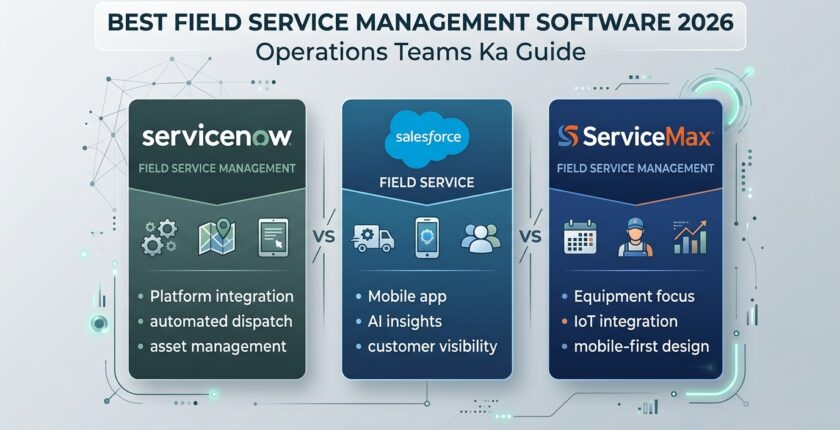
Best Field Service Management Software: ServiceNow vs Salesforce Field Service vs ServiceMax — The Operations Leader’s No-Hype Guide
Your Operations Are Bleeding Value — And It’s Not Your Technicians’ Fault
The Silent Revenue Killer Inside Your Service Supply Chain
Let me tell you about Maria.
She’s a seasoned dispatcher at a mid-sized HVAC provider. It’s 7:15 a.m. and she’s already playing phone tag with a tech who’s en route to the completely wrong site. Meanwhile, a critical chiller sits idle at a hospital that’s paying for a 4-hour SLA. Maria’s not the problem. Her field service dispatch software is — or rather, the complete absence of anything that deserves that name.
Across this industry, I’ve watched businesses leak 9 to 12% of their annual service revenue purely because the back office can’t align the right technician, the right part, and the right asset history at the same moment. The culprit isn’t lazy people. It’s a fractured work order lifecycle, zero enterprise asset management visibility, and no single source of truth that anyone actually trusts. When a technician shows up without knowing what happened during the last three visits, first-time fix rate craters and SLA penalties start stacking up like unpaid invoices nobody wants to sign.
That’s not a scheduling headache. That’s a margin wound bleeding out every single quarter.
When “Good Enough” Software Guarantees You’ll Lose Your Next Contract
Fast-forward to 2026. Your biggest customer no longer accepts “we’ll dispatch someone by end of day” as a promise. They want outcome-based service SLAs tied to equipment uptime — not just response speed. If you can’t guarantee 99.5% uptime and back it with automated audit trails, their procurement team will hand that contract to a competitor who can.
Without blinking.
This is exactly where legacy service operations management tooling crumbles. Systems that can’t ingest IoT data or flag asset failure before it happens lock you into reactive mode while rivals sell predictive uptime as a premium service line. Ask yourself honestly — would your current setup survive a quarterly business review with a Tier 1 customer who just found out they’re paying for 17% unnecessary truck rolls?
If that question made your stomach drop a little, you’re already losing ground.
The 2026 Mandate You Can’t Afford to Ignore
Operations leaders aren’t just deploying software anymore. They’re building a field service digital transformation backbone that has to carry real operational weight — day in, day out. AI-powered technician scheduling software, generative technician-assist interfaces, and IoT predictive maintenance automation have moved from lab experiments to genuine table stakes. Your mobile workforce expects the same intuitive, offline-ready mobile field service app experience they get in their personal lives.
Miss that shift, and you’ll be competing for both talent and customer loyalty with one hand tied behind your back.
That’s precisely why the conversation has changed. It’s no longer if you need modern field service management software. It’s which platform aligns with your specific service model — and that’s a very different, much harder question.
Meet the Three Titans: ServiceNow, Salesforce Field Service, and ServiceMax
ServiceNow FSM — The Process Orchestrator for IT-Habituated Enterprises
ServiceNow Field Service Management was born from IT service management DNA, and you can feel it in every workflow. It excels at orchestrating complex back-end processes — procurement, HR, IT — running alongside field tasks without friction. For ops teams already living inside an ITIL framework, it kinda feels like coming home. The dynamic field service scheduling optimization engine and cross-department workflow automation can enforce service level agreement management with near-zero manual intervention.
But here’s my honest take.
If your primary world is pure asset maintenance without a strong ITSM backbone underneath, ServiceNow can feel genuinely over-engineered. You’ll pay for capability you never touch, and the licensing model has a funny habit of triggering tense finance conversations right around renewal time.
Salesforce Field Service — The CRM-Connected Dispatcher That Sales Teams Already Love
Salesforce Field Service extends the Customer 360 — directly tying field visits to sales opportunities, contract renewals, and account health. If your service organization is closely coupled with revenue growth and upselling motions, that field service CRM integration is a genuine game-changer. Einstein AI powers appointment routing and smart scheduling that automatically bumps a top-tier customer to the front of the queue without a human making that judgment call every morning.
That said — and this matters enormously for certain industries — the asset data model is less industrial-strength out of the box than dedicated tools. When I work with manufacturers maintaining complex machinery, the asset hierarchy feels too shallow for what they actually need. You can extend it through customization. But that has a cost, and it’s almost always bigger than the initial estimate on the SOW.
ServiceMax — The Asset-Centric Heavyweight for High-Stakes Equipment
ServiceMax was built from the ground up around one thing: the asset. Every work order, spare part, and service contract management line item orbits a specific serialized piece of equipment — a genuine asset lifecycle management view that industrial teams actually need to function. For medical devices, heavy equipment, or energy infrastructure, this architecture isn’t a nice-to-have.
It’s non-negotiable.
Native IoT predictive maintenance connectivity lets you trigger work orders directly from sensor threshold breaches — no middleware prayer required, no Frankenstein integrations duct-taped together by someone who no longer works there.
The trade-off? ServiceMax is lighter on non-asset service models, and integrating deeply with a core CRM requires deliberate upfront architecture decisions. If your business mixes asset-intensive and non-asset work, plan that integration layer before you sign anything. Before the demo, honestly.
Head-to-Head Firepower: What Actually Decides the Fate of Your Service Operations
Scheduling & Dispatch Intelligence: Who Puts the Right Tech in Front of the Right Machine?
All three platforms now claim AI-powered scheduling. Their philosophies, though, are genuinely different — and that difference matters more than the feature names suggest.
ServiceNow’s Workforce Optimization leans on constraint-based algorithms that work beautifully when you have rigid SLA windows and complex multi-step tasks requiring spare parts management coordination. Salesforce Einstein Scheduling shines at matching technician skills to customer preferences, especially when minimizing appointment windows has direct revenue impact across your connected field service model. ServiceMax’s optimizer was purpose-built for asset-heavy environments where preventive maintenance scheduling windows must align with production downtime that nobody wants to extend by a single hour.
My Rule of Thumb Here
If your biggest operational pain is technician utilization rate and windshield time — which it is for most operations teams I talk to — test all three platforms with real historical data. Not a canned demo scenario carefully engineered to make everything look frictionless. Real data. Your messiest data. The dispatching scenarios that actually kept Maria up at night.
The Technician’s Reality: Mobile Experience When Connectivity Dies
I’ve stood in a hospital basement with zero cell signal and watched a tech scribble repair notes on his glove box because his “offline” app refused to load the asset history. True story. Not a hypothetical. Genuinely frustrating to watch, and expensive for everyone downstream.
True offline-first capability in a mobile field service app is still a real differentiator in 2026 — don’t let any vendor wave it away. Salesforce Field Service handles offline reasonably well for standard scenarios, but heavy offline usage with spare parts management and inventory transactions needs meticulous configuration that doesn’t happen by default. ServiceMax has invested heavily in offline resilience for complex asset data — it shows in the field, especially for equipment maintenance software use cases in remote environments. ServiceNow’s mobile experience is solid overall, though I’ve seen teams struggle specifically when capturing non-serialized parts inventory without any connectivity at all.
Small difference on paper. Enormous difference at 6 a.m. in a basement with a surgeon waiting upstairs.
Asset & IoT Integration: From Reactive Fixing to Predictive Revenue
If you’re managing industrial compressors or medical imaging devices, IoT predictive maintenance isn’t a buzzword somebody put on a slide. It’s your actual margin engine. ServiceMax’s native IoT edge triggers work orders directly from sensor threshold breaches — clean, fast, no middleware required. ServiceNow integrates through partners and its own operational technology bridges with solid remote asset monitoring capability. Salesforce leans on IoT Cloud and external connectors that work well when configured correctly and become a headache when they’re not.
The real choice depends on how many sensors you already have streaming data and whether your IT architecture can absorb the volume without creating the kind of CMMS software nightmare that breaks at 2 a.m. on a Sunday when nobody’s on call.
SLA & Compliance: The Fine Print That Can Cost You Millions
In pharma, aerospace, and utilities, every wrench turn needs a complete audit trail. No exceptions ever. ServiceNow’s compliance engine is formidable — out-of-the-box SLA management software with breach escalation that genuinely works under pressure. ServiceMax’s warranty management software and entitlement tracking prevent leakage by tying every action to a contract line item — critical when a missed link costs six figures in a single quarter. Salesforce handles compliance but typically requires more custom service delivery management workflow rules to reach the same destination.
I’ve personally seen companies lose six-figure compliance rebates because their software couldn’t prove a technician was certified for a specific procedure on a specific date. Not because the tech wasn’t certified. Because the platform couldn’t prove it. That’s a painful, completely avoidable way to lose serious money.
Total Cost of Ownership: The Numbers Your CFO Will Actually Scrutinize
Licensing models vary wildly — per user, per asset, per work order, hybrid structures that take three separate meetings to fully unpack. ServiceNow’s model inflates quickly when you include large numbers of occasional users. Salesforce Field Service pricing often ties into broader Sales and Service Cloud commitments that feel like a landlord you can’t leave. ServiceMax traditionally priced per technician, but newer models layer in asset-based fees that catch people off guard.
And then there are the hidden costs. There are always hidden costs.
Field service software implementation timelines, customization work to connect ERP and CRM systems properly, ERP integration for field service data cleansing that nobody budgeted for in the original business case. I always tell clients: budget at least 30% over your initial subscription estimate for year-one integration and field service analytics setup work. Every single time. The ones who don’t listen call me six months later. Without fail.
The Operations Leader’s Selection Framework (Steal This Before Any Demo)
Diagnose Your Field Service Maturity Before You Even Open an RFP
Here’s a question most people skip entirely: are you trying to optimize schedules, or are you gearing up to sell uptime-as-a-service through a full connected field service model? Those are genuinely different problems that need genuinely different tools.
I map clients onto a field service maturity model: break-fix → preventive → predictive → outcome-based. Still in break-fix mode? ServiceNow or Salesforce might accelerate your process standardization faster and get your field service KPIs moving in the right direction. Pushing toward outcome-based service revenue? ServiceMax’s asset DNA usually becomes the sharper instrument. The entire point is aligning platform philosophy with your actual service transformation stage — not a generic “best software” label some analyst handed you in a 43-page report.
7 Questions Vendors Hope You Won’t Ask
From years of sitting in these demos, here’s what actually exposes the real gaps.
Ask the uncomfortable questions right there in the room. “Show me how a tech logs a non-serialized part in offline mode.” Watch what happens. “Can your engine auto-prioritize an SLA breach from a top-5 customer without a human creating a rule?” Silence is an answer. “Where does spare parts management inventory get decremented — in the mobile app, or only after a nightly sync?”
Their body language tells you as much as the words. I’ve built a field-tested checklist from these sessions that’s saved clients an average of $140,000 in rework costs. Not magic. Just asking the questions vendors hope you’re too polite to raise.
Why Your ERP and CRM Will Make or Break Your FSM Investment
A brilliant technician scheduling software engine becomes an expensive whiteboard if it can’t real-time sync inventory levels from your ERP. Full stop. ServiceNow integrates cleanly with SAP and Oracle ecosystems and handles plant maintenance software connections well. Salesforce connects natively to its own CRM and through MuleSoft to others — great when MuleSoft is already in your stack, genuinely frustrating when it isn’t. ServiceMax offers deep ERP integration for field service hooks into SAP Plant Maintenance and Oracle that industrial operations teams genuinely appreciate during go-live week.
The real risk isn’t the software choice. It’s underestimating data cleanliness and integration latency. If your item master is a mess — and honestly, whose isn’t — no field service automation layer will clean it up for you.
The Silent Reason 62% of Teams Choose Wrong — And How You’ll Sidestep It
Feature Overwhelm Paralysis: Why “Best Overall” Means Nothing for Your Specific Fleet
Reading 43-page analyst reports leaves most operations leaders more anxious than informed. Genuinely. I’ve watched brilliant directors freeze because every vendor claims the same service operations management capabilities in slightly different language. The truth is simple and uncomfortable: “best overall” doesn’t exist. There is only “best for your asset complexity, your connectivity reality, and your service delivery management model.”
A generic listicle will never tell you that your specific need for offline mobile inventory management in remote mining operations completely trumps a vendor’s fancy field service analytics dashboard that looks great on a demo screen and gets ignored in the field.
Never.
Enter Our FSM Fitment Engine: Built by Ops Vets, Not Analysts
That’s exactly why we built a decision-support tool that doesn’t generate a one-size-fits-all ranking applicable to any company in any industry anywhere on the planet.
Our FSM Fitment Engine weights your actual operational reality — asset complexity, mobile connectivity requirements, workforce management software maturity, service contract management depth, and real budget constraints — then generates a ServiceNow vs Salesforce vs ServiceMax fit score built specifically for your fleet. Validated against 400+ real-world deployments. You’re not guessing. You’re calibrating against something that’s actually been tested in environments like yours.
Don’t Let Another Quarter Slip Away with a Tool That Fights Your Team
Get Your Customized Operations-Grade Scorecard in Under 5 Minutes
I designed a short, zero-fluff questionnaire that delivers a weighted, personalized recommendation complete with field service software implementation risk flags your RFP process would never surface on its own. You’ll receive a one-page executive summary you can take straight to your next steering committee — no jargon, just actionable clarity on which field service management software platform actually aligns with your 2026 roadmap.
It’s the kind of decision support that prevents a $400,000 misfire. And those misfires are far more common in this industry than anyone wants to admit publicly.
Still Not Sure? Join 3,000+ Ops Leaders Who’ve De-Risked Their FSM Purchase
Come inside our buyer community where peers share anonymized scorecards, real field service automation implementation post-mortems, and the exact questions that made vendors squirm during live demos.
At worst, you walk away armed with the service dispatch software demo questions that expose gaps nobody warned you about. At best — you skip the costly mistake of deploying a work order management system that fights your team every single day, and instead build a service operation that becomes your sharpest competitive edge going into 2026 and beyond.
That’s genuinely worth ten minutes of your time.